

Table of Contents
Mobile App Development
iOS, Android and cross-platform apps
- ✔️ Native and cross-platform builds
- ✔️ App design, APIs and admin panels
- ✔️ Store submission and release support
- ✔️ Maintenance after launch

A mobile application development company that builds decision-intelligent applications combines data engineering, contextual analytics, and user-centered design to turn everyday mobile interactions into actionable business insights. The objective goes beyond adding an AI chatbot or predictive feature: it is to help people make better decisions, faster, using information that is relevant to the situation at hand.
For businesses, this distinction matters. Mobile applications have become essential operational tools for sales teams, field technicians, financial professionals, healthcare providers, and executives. Yet many apps still function primarily as digital interfaces for existing processes. They collect information, display dashboards, and automate routine tasks without helping users understand what deserves attention or what to do next.
The next stage of mobile innovation is about closing that gap between information and action.
Table of Contents
From Feature-Rich Apps to Decision-Driven Products
Adding more functionality does not necessarily make an application more intelligent. A dashboard with twenty charts may contain more information than a simple notification, but it can be less useful if the user cannot identify the underlying problem.
Decision-driven applications start with a different question: What decision should this user be able to make better?
Consider a mobile application used by a retail operations manager. A conventional solution might display daily sales, stock levels, and customer traffic. A decision-oriented version could identify products at risk of running out, compare demand against replenishment schedules, and recommend which locations need immediate attention.
The difference is architectural as much as functional. The application must connect operational data with business objectives, interpret relevant signals, and present the results within the user’s workflow.
Before development begins, teams should identify the decisions that matter most, the people responsible for making them, and the measurable outcomes that define success. Revenue growth, reduced waste, faster response times, and improved customer retention are stronger design targets than a generic ambition to make an app “AI-powered.”
The Data Architecture Behind Better Decisions
An intelligent interface is only as reliable as the information supporting it. In many organizations, relevant data is distributed across CRM platforms, ERP systems, payment gateways, inventory databases, and external services. Bringing these sources together is often more challenging than implementing the AI model itself.
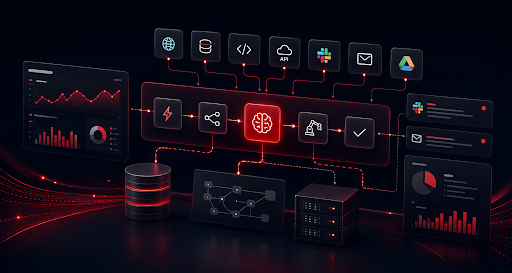
A robust architecture typically includes an integration layer, a governed data pipeline, an analytics engine, and APIs that deliver contextual insights to the mobile client. Depending on the use case, processing may happen in the cloud, on the device, or across both environments.
For example, an insurance application might combine claims history, policy details, and submitted documents to help an adjuster prioritize cases. The backend handles complex analysis, while the mobile interface presents the relevant evidence and recommended next steps.
Data quality is equally important. Incomplete records, stale information, and inconsistent definitions can undermine even sophisticated machine learning models. Teams should establish data validation rules, ownership policies, and lineage tracking before relying on automated recommendations.
Choosing the Right AI Architecture
Not every business problem requires a large language model. In fact, selecting the simplest effective approach often produces more dependable results.
- Predictive models estimate outcomes such as customer churn, equipment failure, or demand fluctuations.
- Recommendation engines rank products, actions, or opportunities according to context and business objectives.
- Rules engines enforce explicit policies where decisions must remain deterministic and auditable.
- Large language models (LLMs) interpret unstructured information, summarize documents, and enable natural-language interaction.
- Optimization algorithms identify efficient schedules, delivery routes, or resource allocations under defined constraints.
These technologies can work together. A logistics app, for instance, might use predictive analytics to estimate delivery delays, an optimization algorithm to recalculate routes, and a language model to summarize the operational impact for a dispatcher.
The critical engineering decision is determining where each method adds value—and where automation introduces unnecessary risk.
Designing for Decisions, Not Just Screens
Even an accurate recommendation can fail if users cannot understand or act on it. Mobile interfaces impose particular constraints: limited screen space, intermittent connectivity, short interaction windows, and varying levels of user attention.
Decision-focused design prioritizes three elements: context, evidence, and action.
A useful recommendation explains what has changed, why it matters, and what the user can do about it. Where appropriate, it should communicate confidence levels, relevant data sources, and the consequences of alternative actions.
Consider a field-service application that flags a machine as likely to fail. Simply displaying a warning creates another task for the technician. Showing the affected component, supporting sensor readings, recommended inspection steps, and available replacement parts makes the warning operationally useful.
Offline capabilities also deserve attention. Local caching, queued actions, and conflict-aware synchronization can preserve essential workflows when connectivity disappears. For sensitive decisions, the application should clearly distinguish current information from cached data.
Governance, Security, and Human Oversight
Business decision-making introduces risks that ordinary feature development may overlook. An incorrect recommendation can affect revenue, customer relationships, regulatory obligations, or employee safety.
Security controls should include encryption, least-privilege access, secure API communication, and appropriate retention policies. Sensitive information should not be sent to external AI services without a clear legal, contractual, and technical basis.
Organizations also need mechanisms to monitor model performance and detect changing data patterns. A recommendation system trained on historical purchasing behavior, for example, may become less reliable when market conditions shift.
Human oversight remains essential when decisions carry substantial consequences. Teams should define which actions can be automated, which require approval, and how users can challenge or override recommendations. Audit logs should capture relevant inputs, model versions, outputs, and human interventions where appropriate.
Measuring Business Impact After Launch
Downloads, session duration, and feature adoption reveal how people use an app, but they do not establish whether it improves decisions.
More meaningful metrics depend on the business problem. These might include reduced stockouts, fewer missed appointments, shorter approval cycles, improved forecast accuracy, or lower customer acquisition costs.
Teams should establish baseline measurements before launch and compare results against a defined control group or another credible evaluation method where feasible. They should also monitor unintended consequences: a system that reduces processing time but increases error rates has not necessarily improved performance.
Start with a narrowly defined use case, validate its impact, and expand only when the evidence supports further investment.
Conclusion
Mobile applications become genuine business assets when they connect reliable data, appropriate analytical methods, intuitive interfaces, and accountable decision-making. AI can strengthen this combination, but it cannot compensate for weak data foundations, poorly designed workflows, or unclear business objectives.
Choosing a capable mobile application development company as a technology partner can help organizations connect product strategy with mobile engineering, secure integrations, analytics, and scalable architecture. For example, Andersen’s mobile development services span discovery, architecture, implementation, quality assurance, and ongoing support. The strategic priority, however, remains the same for any development initiative: build around the decisions people need to make, then measure whether the application helps them make those decisions better.














Leave a Reply