

Since 2009
Seventeen years of shipping software for startups and enterprises, across every major shift in the web stack.


APIs, data models, authentication, integrations, queues and cloud infrastructure — designed, built and operated by one senior team that picks Node.js, Python or Laravel for your workload, not out of habit.













Building the systems behind web and mobile products since 2009

Contract-first REST or GraphQL APIs with versioning, pagination, rate limits and generated documentation, so web, mobile and partner clients can integrate without guesswork.
Relational schemas in PostgreSQL or MySQL, document models in MongoDB where they fit, with indexes, migrations and constraints designed around how the data is actually queried.

Email, social, SSO and mobile OTP sign-in, JWT or session auth, and role- and permission-based access enforced in the back end — never only in the UI.

Payment gateways, CRMs, ERPs, maps, SMS, email and AI APIs connected through idempotent webhooks and retrying sync jobs, so one provider's outage doesn't corrupt your data.
Notifications, report generation, billing runs, subscription expiry and data imports processed by queue workers and schedulers, off the request path.

Secure admin interfaces for managing users, content, orders and reports — custom-built, or on a headless CMS when content editing is the main job.

Containerised deployments on AWS, Azure or DigitalOcean, CI/CD pipelines, managed databases, backups and environment separation from day one.

Legacy PHP, monolithic or undocumented back ends stabilised, covered by tests and moved step by step to a maintainable architecture — without stopping the business.
Platforms where the hard part was the logic behind the interface: billing, permissions, search and data.
A back end is judged by what happens on its worst day. We design for that day from the start.
Seventeen years of shipping software for startups and enterprises, across every major shift in the web stack.

Independently certified information security — the baseline enterprise procurement checks.


Nine in ten clients come back for their next project — the most honest measure of delivery quality.


Verified client reviews collected independently by Clutch.


We build in Node.js, Python and Laravel, so our recommendation follows your workload, your team and your hosting — not the only language we know.

Logs, metrics, alerts, backups and runbooks are part of the deliverable, so you can see what the system is doing and recover when something fails.
 A practical guide to backend development
How to choose a back-end stack, what a production back end actually includes, and how to design for scale, security and day-to-day operations.
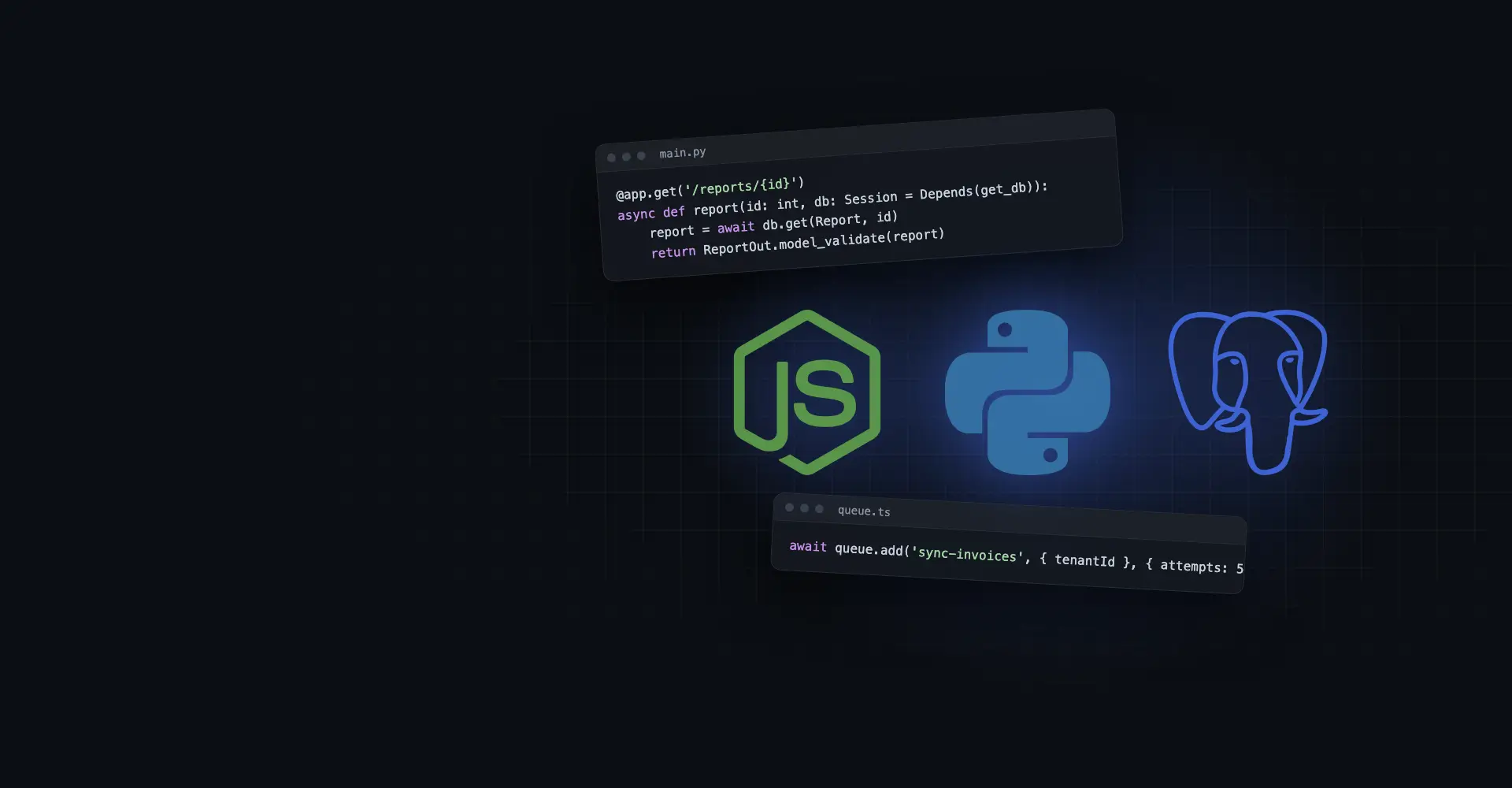
There is no best back-end language — there is a best fit for your workload, your team and your roadmap. We build in all three mainstream options and choose based on what the system spends its time doing and who will maintain it after launch.

Best for APIs behind React and Next.js, real-time features and integration-heavy services. See Node.js development.
Best for data pipelines, AI and LLM features, scraping and analytics. See Python development.
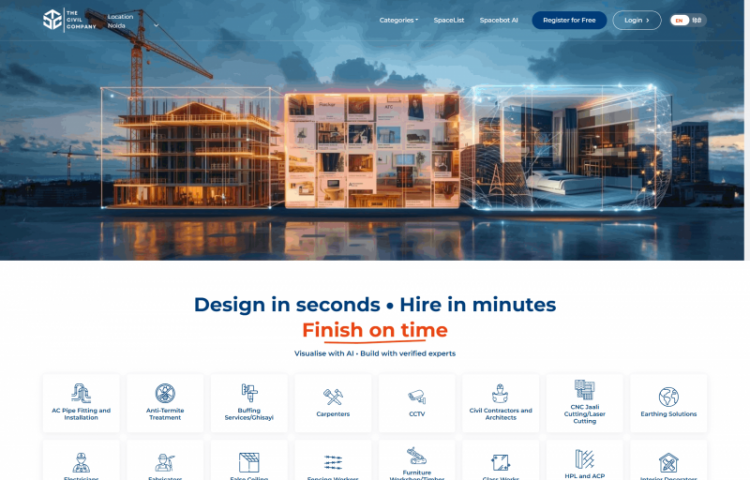
Best for business applications, marketplaces and portals where mature conventions and affordable hosting matter — as on The Civil Company.
Key takeaway: choose the stack for the work the system does and the team that will own it; a well-built back end in any of the three will outlast a fashionable one built carelessly.
A demo back end is a database and some endpoints. A production back end also decides who can do what, how failures are retried, how data gets in and out of other systems, and how the operations team sees what's happening.

Simple, cacheable and easy for partners to consume; our default for public and mobile APIs.
Useful when many clients need different shapes of the same data; needs care with query cost and caching.
Key takeaway: ask any vendor how they handle permissions, retries, background jobs and backups — the answers separate a production back end from a prototype.
Most back ends don't fail because traffic grew tenfold overnight; they fail because a slow query, a missing index or a synchronous third-party call was never noticed. We design for growth by planning data volumes, caching deliberately and making the system observable.
One deployable with clear internal modules. Faster to build, test and change; the right start for most products.
Independent services with their own data and releases. Worth the operational cost when parts need to scale or ship separately.
Key takeaway: start with a modular monolith, measure it properly, and split out services only when the data shows a part needs to scale or change on its own.
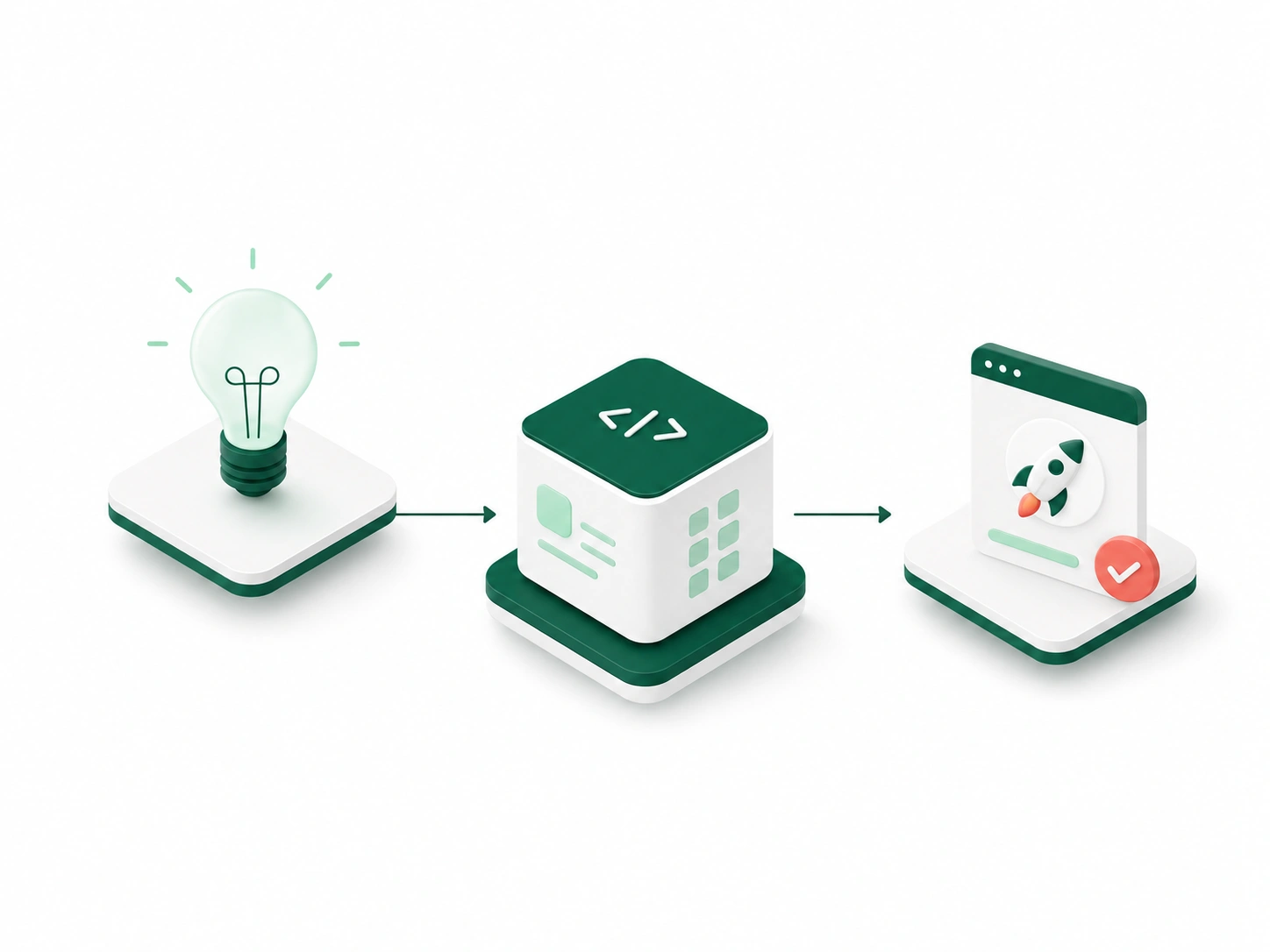
We map entities, workflows, roles and integrations with your team, and estimate data volumes and traffic before choosing a stack.
 Domain & workflow mappingRoles & permissions matrixIntegration inventoryFixed quote & timeline
Stack, database, hosting and service boundaries agreed and written down, with the API contract and schema reviewed before build.
Stack recommendationSchema designAPI specificationInfrastructure planEach sprint delivers working features end to end — endpoint, logic, data and jobs — deployed to a staging environment you can test.
Endpoints & business logicIntegrations & webhooksQueues & schedulersAdmin panelAutomated tests, security review and load testing against the volumes agreed in discovery.
Unit & integration testsAPI contract testsSecurity reviewLoad & failure testingProduction deployment with monitoring, backups and runbooks, then ongoing support, scaling and new features.
CI/CD & rollbacksMonitoring & alertsBackup & restore testsOngoing supportBook a free call with a senior backend engineer — bring your requirements, current system or integration list.

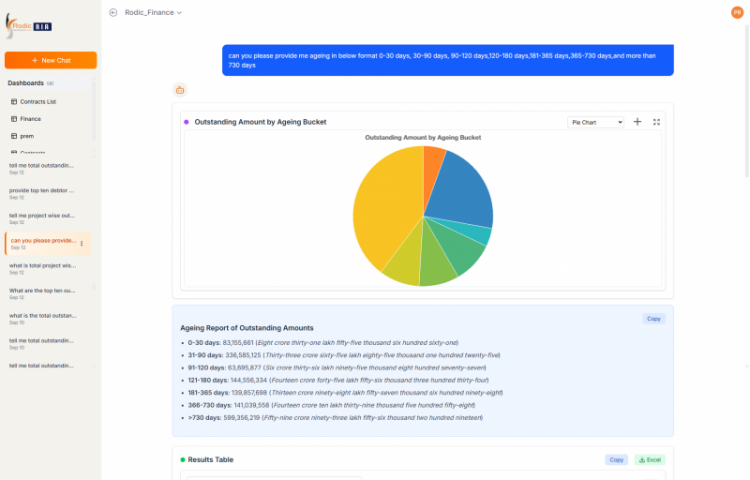
An enterprise learning management system covering onboarding, compliance training, assessments and automated certification, with multiple user roles and real-time analytics — built on a modular, API-driven architecture with optimised database queries.
See case study API-Driven Multiple Roles
  Real-Time Analytics Auto Certification
  Fixed-Scope Backend Build
A defined back end, API or integration layer with agreed scope, milestones and price — ideal for new products and rebuilds.
Fixed scope & pricing Architecture & API docs Infrastructure as code Full handover Dedicated Backend Team
Backend engineers working inside your team on your roadmap, in Node.js, Python or Laravel.
Full-time engineers Your sprint cadence Scale up or down Named tech lead Time & Materials
Flexible capacity for audits, integrations, performance fixes and evolving requirements, billed on actual effort.
Pay for hours used Change priorities anytime Weekly reporting No long lock-inNot sure which fits? Tell us about your project and we'll recommend one.
Schedule a call
First-hand experiences from brands that scaled smarter, innovated faster, and achieved measurable growth with VOCSO.
View all client testimonials“Vocso team has really creative folks and is very co-operative to implement client project expectations. MicroSave Consulting had great experience working with Anju and Prem.”

“Working with Deepak and his team at Vocso is always a pleasure. They employ talented staff and deliver professional quality work every time.”

“We love how our website turned out! Thank you so much VOCSO Digital Agency for all your hard work and dedication.”

“VOCSO SEO & SEM services helped me find new customers in a small budget. Their advanced SEO strategies made us visible to everyone.”

“Vocso team has really creative folks and is very co-operative to implement client project expectations. MicroSave Consulting had great experience working with Anju and Prem.”
“Working with Deepak and his team at Vocso is always a pleasure. They employ talented staff and deliver professional quality work every time.”
“We love how our website turned out! Thank you so much VOCSO Digital Agency for all your hard work and dedication.”
“VOCSO SEO & SEM services helped me find new customers in a small budget. Their advanced SEO strategies made us visible to everyone.”
You delivered exactly what you said you would in exactly the budget and in exactly the timeline.







 Transparency on every decision Talented Team of AI Engineers Smooth Collaboration & Reporting Efficient & Adaptive Workflow Strict Privacy Assurance with NDA 12 Months Free Post-Launch Support On-time Delivery, No Surprises ISO 27001 Certified Engineering
Tell us what your system needs to do, who uses it and what it connects to. We'll recommend a stack and architecture, flag the risks, and give you a fixed quote for a defined scope.
deepak@vocso.com — straight to a senior team member.
Everything that runs on the server: APIs, database design, business logic, authentication and permissions, third-party integrations, background jobs, admin panels and the cloud infrastructure they run on. We also set up monitoring, backups and CI/CD so the system can be operated after launch.
Node.js suits I/O-heavy APIs, real-time features and teams using React or Next.js. Python suits data processing, AI and analytics. Laravel suits conventional business applications where mature conventions and affordable hosting matter. We recommend based on your workload and who will maintain it.
For most business applications we recommend a relational database such as PostgreSQL, because orders, payments and permissions depend on consistency and joins. MongoDB fits content and catalogues with varied shapes, and Redis sits alongside either for caching and queues.
Yes. We design the API around the screens and flows your front end already has, add authentication, data and admin features behind it, and document the contract so your front-end or mobile team can integrate cleanly.
Every request is authenticated and authorised on the server, inputs are validated, secrets are kept out of code, sensitive data is encrypted and admin actions are logged. We work under NDA from day one, and VOCSO is ISO 27001 certified.
Usually not at the start. A modular monolith is faster to build and cheaper to run; we split out services when a part of the system needs to scale, deploy or be owned separately, and the monitoring data shows it.
Yes. We begin with an audit of the code, database, dependencies and infrastructure, stabilise the riskiest areas with tests and monitoring, and then modernise step by step rather than rewriting everything at once.
It depends on the number of entities, integrations, roles and the traffic you expect. We give a fixed quote after discovery for defined scopes, or you can hire backend developers monthly. Our web application cost calculator gives a quick ballpark.
Discover complementary services that enhance performance, improve user experience, and help your business build scalable digital solutions efficiently.