

Since 2009
Seventeen years of shipping software for startups and enterprises, across every major shift in the web stack.



We build fast, SEO-ready websites and web apps on Next.js (App Router, server components, SSR and ISR, headless CMS) and migrate sites from WordPress, React and Gatsby. Projects start at $10,000 and most run $30,000 to $150,000. Our Next.js and Strapi build for Colleges18 earned 4.85M search impressions in its first three months.













 Reviewed by Deepak Chauhan, Founder & CEOLast updated
Building for the web since 2009

Marketing and content sites with server-side rendering, static generation and incremental revalidation, so every page is fast and indexable.

Portals, dashboards and multi-tenant SaaS on the App Router, with authentication, role-based access and API routes in one codebase.

Strapi, Directus or headless WordPress for editors, Next.js for visitors: structured content, draft preview and on-demand revalidation when content changes.

Fast storefronts on Next.js connected to your commerce back end or custom APIs, with product search, filters and a lightweight checkout flow.

Move from WordPress, a Create React App or Vite SPA, or Gatsby to Next.js without losing rankings: URL mapping, redirects and parity testing built in.

Audits and fixes for LCP, INP and CLS: image and font strategy, bundle splitting, caching and moving work to server components.

Route handlers, server actions and Node.js services for integrations, queues and business logic that sit behind your Next.js front end.

Pages Router to App Router upgrades, version bumps, dependency hygiene and monitoring, so your Next.js app stays current and secure.
Education portals, enterprise platforms and our own SaaS, where search, dashboards and thousands of pages have to stay fast.
Senior engineers who understand rendering, caching and SEO — not just React components.
Seventeen years of shipping software for startups and enterprises, across every major shift in the web stack.

Independently certified information security — the baseline enterprise procurement checks.


Nine in ten clients come back for their next project — the most honest measure of delivery quality.


Verified client reviews collected independently by Clutch.


Server rendering, metadata, structured data and clean URLs are part of the architecture, not a plugin added at the end.

Strapi and Directus specialists, so your content model and your front end are designed together.

When Next.js is the right choice, how we architect it, and how to migrate an existing site without losing traffic.
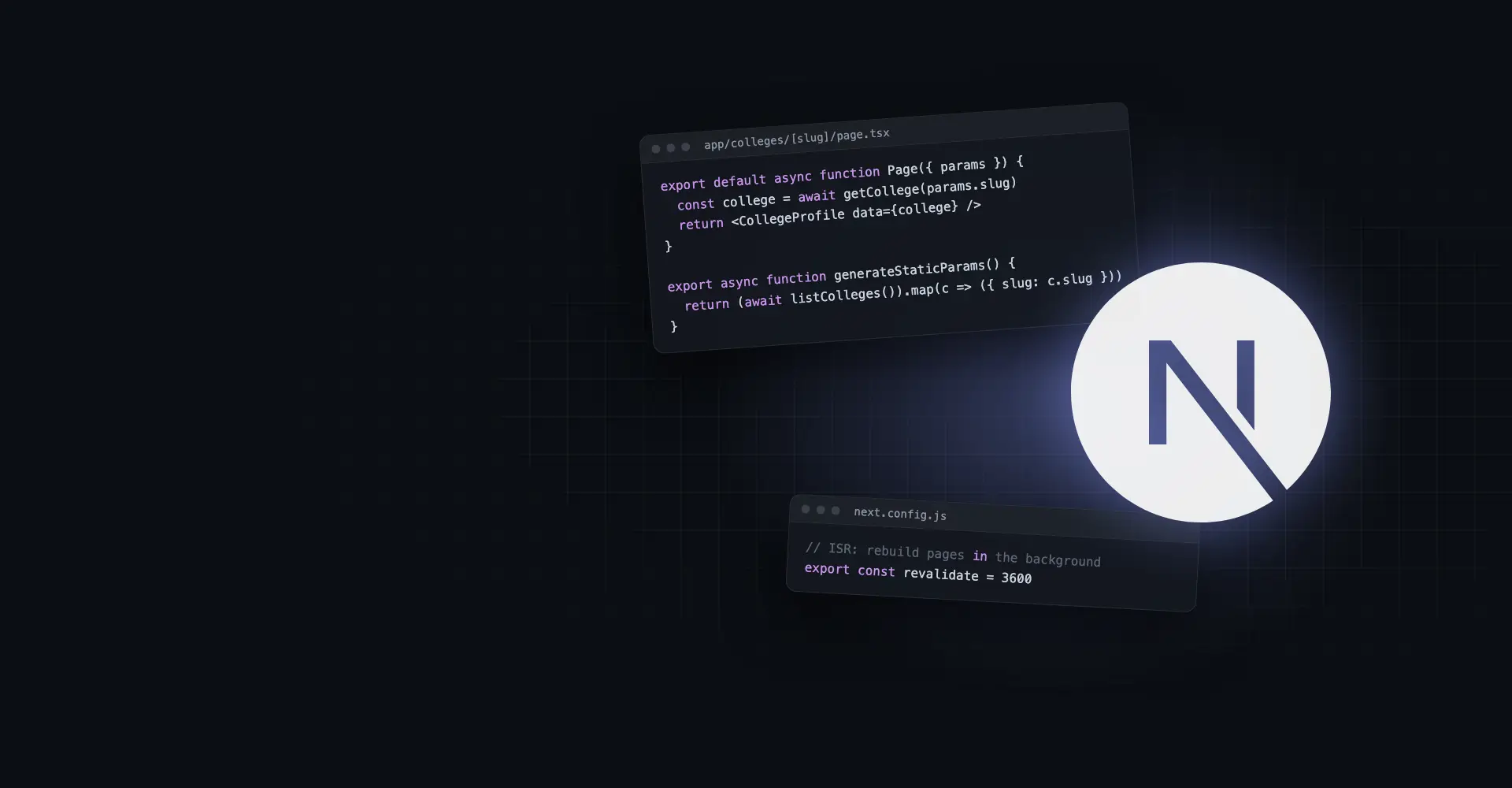
Next.js development is building websites and web applications on Next.js, the React framework that renders each page on the server, at build time or on demand, and sends the browser only the JavaScript that page needs. Done well, it gives you pages that load fast, are fully indexable and can grow from a marketing site into logged-in dashboards in one codebase. At VOCSO we build on the App Router with server components and TypeScript, and we decide rendering per route: static generation for marketing pages, incremental static regeneration (ISR) for large catalogues, and server-side rendering for personalised views. Content usually comes from a headless CMS such as Strapi, with on-demand revalidation when editors publish. Every build has Core Web Vitals budgets and SEO checks in CI. That is how Colleges18 serves more than 12,000 college listings on Next.js and Strapi without full rebuilds.
We'll say so if Next.js is overkill:
Server-rendered or static HTML per route, so pages are fast and indexable, and the same codebase can add logins, dashboards and APIs. Needs React skills to maintain.
Renders in the browser, which suits apps behind a login but hurts SEO and first-load speed on public pages. Migrating to Next.js reuses most components. See React development.
Fastest to launch with familiar editing and plugins, and the cheaper choice for content-led sites. It can also run headless behind a Next.js front end. See WordPress website design.
Key takeaway: choose Next.js when speed, search visibility and room to grow into an app all matter — which is most business websites that drive revenue.
Most Next.js problems in production come from rendering and caching decisions made too late. We decide them per route at the start, and document them so your team can extend the app safely.
Fastest path to production, built-in previews and edge caching; best for teams that want zero infrastructure work.
Containers or serverless on your own account for data residency, cost control at scale or existing cloud commitments.
Key takeaway: decide rendering and caching per route up front — it is the difference between a Next.js app that stays fast and one that slows down as it grows.
Moving from WordPress, a React single-page app (Create React App or Vite) or Gatsby to Next.js usually improves speed and indexing, as long as URLs, metadata and redirects are handled as part of the build, not after launch.
Key takeaway: a Next.js migration is also an SEO project — plan redirects and metadata before the first line of code.
Price follows scope, not the framework. The number of unique page templates, the CMS and content model, integrations and any migration work decide the cost. These are our published ranges; a short discovery call turns them into a fixed quote.
A focused Next.js website, a migration of a smaller site or a defined first release.
Where most custom Next.js websites, portals and web apps land, depending on scope.
Monthly Next.js capacity for an ongoing roadmap; the rate depends on experience and hours.
Try the web application cost calculator for a ballpark, hire Next.js developers monthly, or request a fixed quote for a defined build.
Key takeaway: fix the scope first: the same Next.js site can cost very different amounts depending on templates, integrations and migration work.
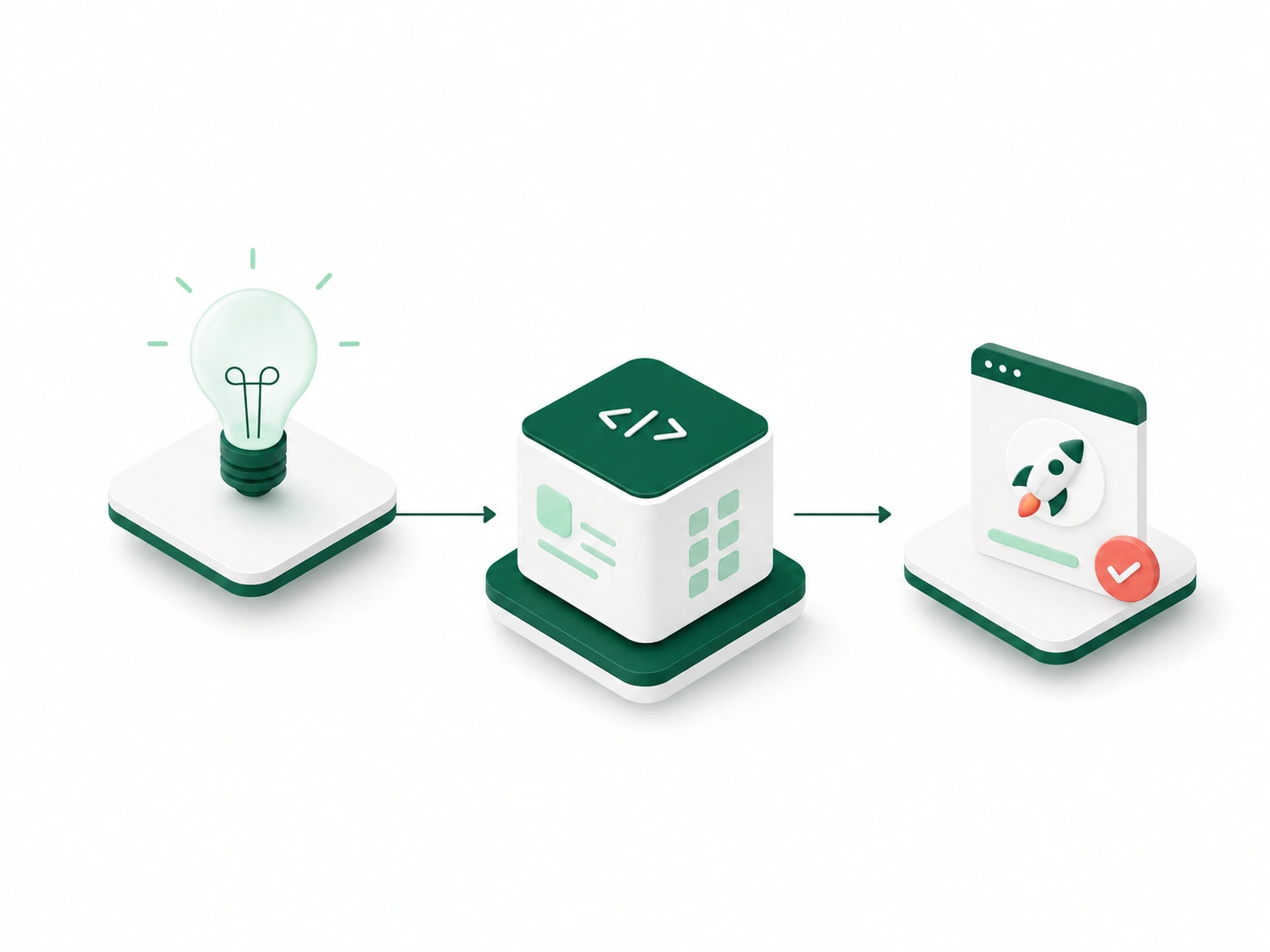
Goals, users and content model first, then rendering, caching and hosting decisions written down before build.
 Technical workshopRendering plan per routeCMS & data modelFixed quote & timeline
Wireframes and UI design in Figma, turned into a reusable component library that maps one-to-one to code.
WireframesUI design systemResponsive layoutsAccessibility reviewTwo-week sprints with preview deployments for every change, so you review working pages, not screenshots.
App Router & componentsCMS integrationAPIs & integrationsPreview deploymentsAutomated tests, Core Web Vitals budgets and SEO checks gate every release.
Unit & E2E testsLighthouse budgetsSEO & schema checksSecurity reviewZero-downtime launch with redirects and monitoring in place, then ongoing improvements and upgrades.
Redirects & analyticsMonitoring & alertsTeam handoverOngoing supportBook a free call with a senior Next.js engineer — bring your current site or product idea.

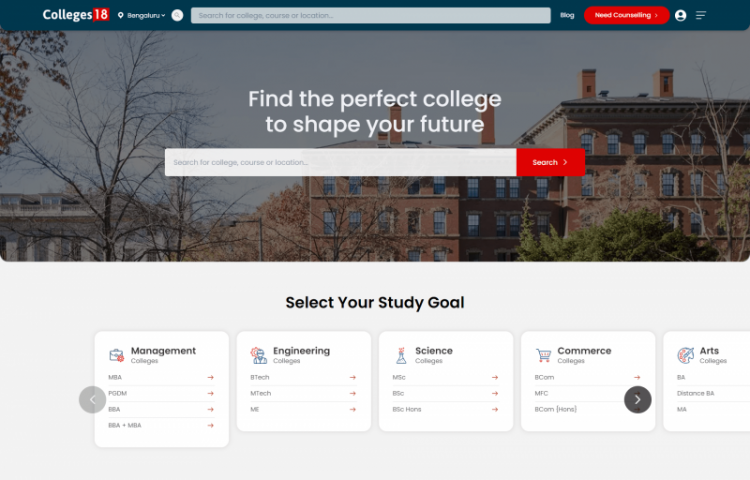
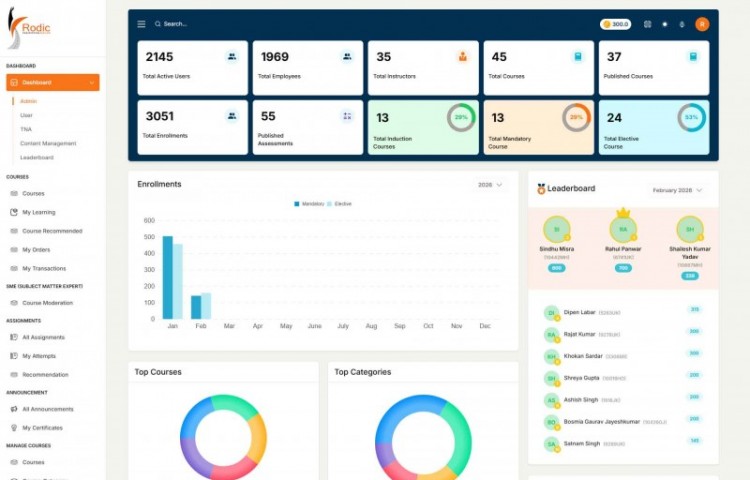
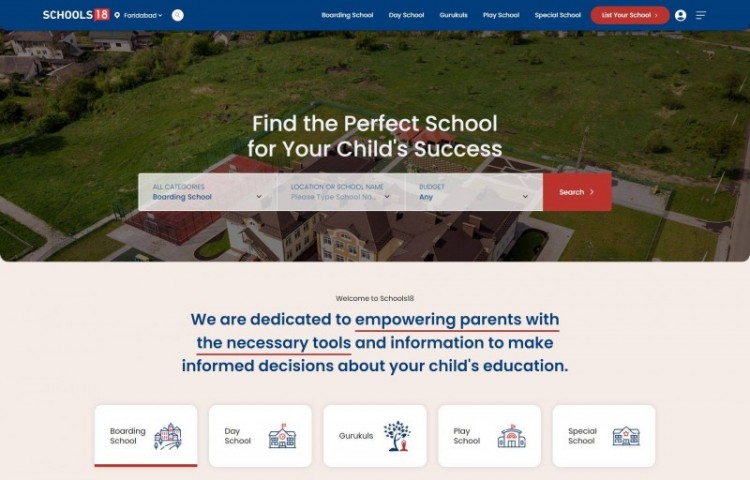
A college discovery portal with search and filters, comparison, reviews and OTP sign-up for more than 12,000 colleges: server-rendered with Next.js, managed in Strapi on a Node.js back end, with programmatic SEO across 50+ page templates. It generated over 500 leads within its first month.
See case study 25.3K
 4.85M 12,000+
 50+
 Fixed-Scope Project
A defined website or app with agreed scope, milestones and price — ideal for new builds and migrations.
From $10,000 Fixed scope & pricing Defined milestones Documentation & handover Dedicated Next.js Team
Senior Next.js engineers working as part of your team, on your roadmap and your tools.
Full-time engineers Your sprint cadence Scale up or down Named tech lead Time & Materials
Flexible capacity for evolving products, audits and performance work, billed on actual effort.
Pay for hours used Change priorities anytime Weekly reporting No long lock-inNot sure which fits? Tell us about your project and we'll recommend one.
Schedule a call
First-hand experiences from brands that scaled smarter, innovated faster, and achieved measurable growth with VOCSO.
View all client testimonials“Vocso team has really creative folks and is very co-operative to implement client project expectations. MicroSave Consulting had great experience working with Anju and Prem.”

“Working with Deepak and his team at Vocso is always a pleasure. They employ talented staff and deliver professional quality work every time.”

“We love how our website turned out! Thank you so much VOCSO Digital Agency for all your hard work and dedication.”

“Vocso team has really creative folks and is very co-operative to implement client project expectations. MicroSave Consulting had great experience working with Anju and Prem.”
“Working with Deepak and his team at Vocso is always a pleasure. They employ talented staff and deliver professional quality work every time.”
“We love how our website turned out! Thank you so much VOCSO Digital Agency for all your hard work and dedication.”
Senior Next.js engineers, rendering and caching decided up front, and a fixed quote before work starts.








 Transparency on every decision Talented Team of AI Engineers Smooth Collaboration & Reporting Efficient & Adaptive Workflow Strict Privacy Assurance with NDA 12 Months Free Post-Launch Support On-time Delivery, No Surprises ISO 27001 Certified Engineering
Tell us about the site or product you want to build or migrate. We'll recommend an architecture, a realistic timeline and a fixed quote — usually within two working days.
[email protected] — straight to a senior team member.
A Next.js development company designs, builds and maintains websites and web applications on the Next.js framework. At VOCSO that covers architecture (rendering and caching per route), UX and UI design, App Router development, headless CMS integration, APIs and back ends, testing, deployment to Vercel or AWS, and ongoing upgrades. We also migrate existing sites from WordPress, React and Gatsby. The same team has built Next.js platforms such as Colleges18, an enterprise LMS and our own SaaS product, StackRoom. If you need capacity rather than a project, you can hire Next.js developers instead.
Next.js projects at VOCSO start at $10,000, and most custom Next.js websites and web apps cost between $30,000 and $150,000. A focused marketing site or a migration of a smaller site sits at the lower end. Portals, SaaS products and large programmatic sites with many templates and integrations sit at the upper end. For ongoing work, dedicated Next.js developers start from around $1,000 a month depending on experience and hours. After a short discovery call we give a fixed quote. The web application cost calculator gives a quick ballpark.
Yes. Next.js is one of the best frameworks for SEO because server rendering and static generation deliver complete HTML to search engines, and it has built-in support for metadata, sitemaps and structured data. Most SEO problems we fix on Next.js sites come from rendering public pages on the client, missing canonicals or slow images. We avoid them by deciding rendering per route and checking metadata in CI. Colleges18, built on Next.js and Strapi, earned 25.3K organic clicks and 4.85M impressions in its first three months. Our Next.js SEO checklist lists the details.
Use the App Router for new projects. Server components, streaming, nested layouts and the newer caching and revalidation model are built around it, and it sends less JavaScript to the browser. Existing Pages Router apps do not need a big-bang rewrite: both routers can run side by side, so we upgrade incrementally, route by route, while the site stays live. We start with low-risk pages, set up shared layouts and data fetching, and move complex routes last. Our App Router migration guide explains the approach.
Yes. We migrate WordPress sites, React single-page apps built with Create React App or Vite, and Gatsby sites to Next.js. Every migration starts with a full URL inventory, then 301 redirects for anything that changes, metadata and structured data parity, and automated comparison of old and new pages before switch-over. After launch we watch Search Console, analytics and Core Web Vitals for four weeks. With WordPress you can keep it as a headless CMS behind Next.js or move content to Strapi or Directus. React components are largely reused.
For most marketing teams we recommend Strapi or Directus. Both are open source, self-hostable and support structured content, roles and draft preview. Strapi suits teams that want a flexible content model and plugins; Directus suits projects that sit on an existing SQL database. WordPress can also run headless if editors prefer it. Whichever you choose, we wire CMS webhooks to on-demand revalidation so only changed pages refresh. Our headless CMS development page compares the options.
We set performance budgets at the start and check them on every release. For LCP we serve the main image through next/image with correct sizing and priority, self-host fonts and render above-the-fold content on the server. For INP we keep client components small, split heavy scripts and defer third-party tags. For CLS we reserve space for images, embeds and fonts. Lighthouse checks run in CI, and real-user Web Vitals are reported after launch, so regressions show up before rankings move. See our Core Web Vitals guide.
We host on Vercel for the fastest setup and built-in previews, or on your own AWS or cloud account when you need data residency, cost control at scale or existing cloud commitments. Either way we set up CI/CD, preview deployments, error tracking and monitoring. After launch we offer maintenance, Next.js version upgrades, performance monitoring and new features, on time-and-materials support or through dedicated Next.js developers. We also take over Next.js apps built by other teams, starting with a code audit.
Discover complementary services that enhance performance, improve user experience, and help your business build scalable digital solutions efficiently.

Certified, partnered and independently rated