Since 2009
Enterprise software delivery — a track record built across technology cycles, not just the current AI wave.
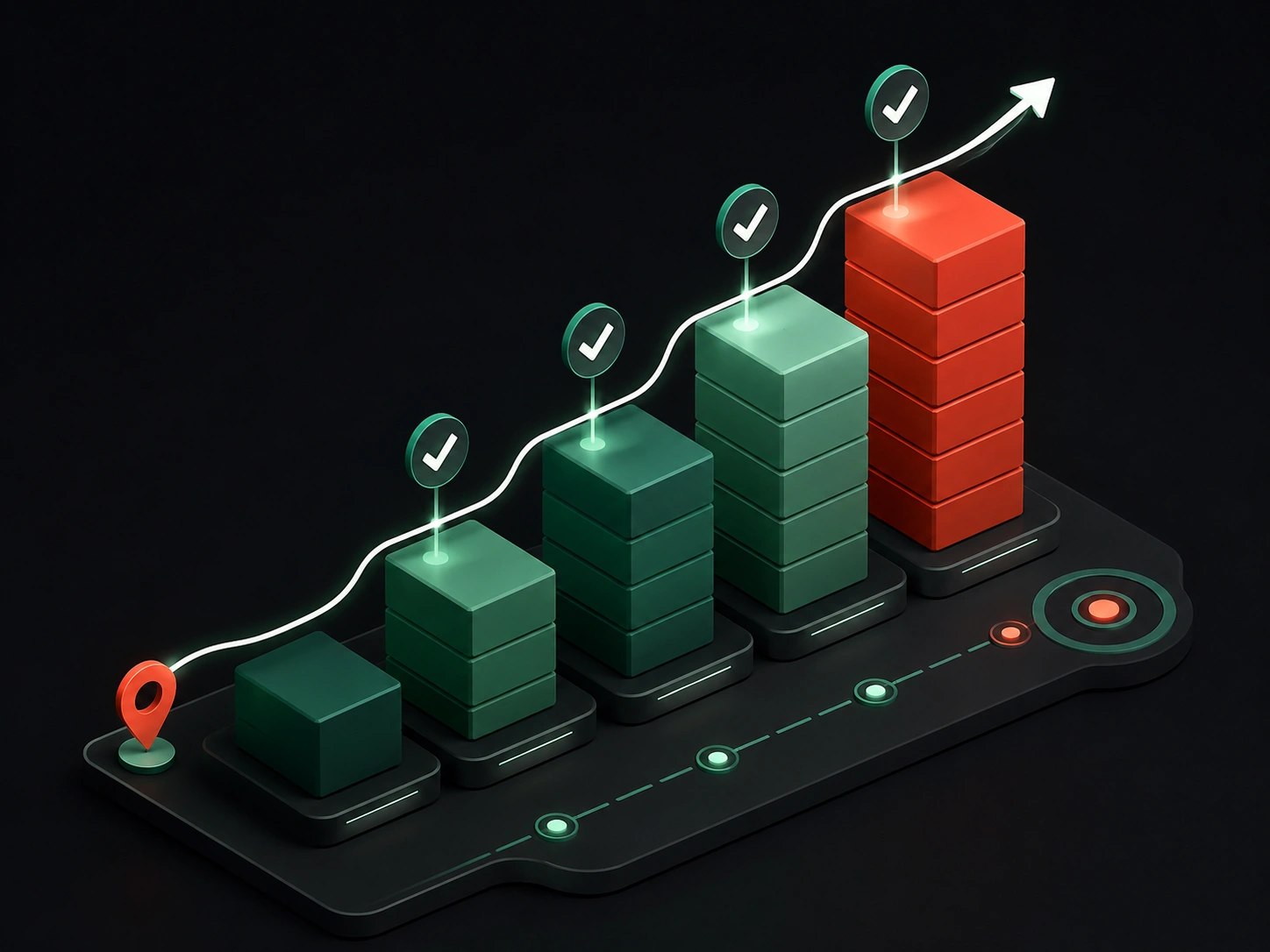


We design, build, and operate AI systems for multi-practice firms running on project economics — from AI agents and enterprise RAG to the VocsoAI product suite. ISO 27001. Structured engagement models.













Building software since 2009, validated in numbers

Map your highest-value AI use cases, score ROI potential, and build a sequenced roadmap — before writing a line of code.
Custom LLM applications for content generation, summarisation, and knowledge synthesis — built on your data, inside your environment.
Make your entire document library queryable in natural language — without exposing proprietary content to public model training.

Autonomous agents that handle multi-step tasks — research, extraction, report drafting, approvals — with human oversight built in.

Conversational interfaces that answer from your documents, policies, and databases — accurate, on-brand, and fully audit-logged.
Predictive models trained on your historical data: project risk, churn, demand forecasting, and anomaly detection.

Connect AI to your existing CRM, ERP, and project management stack — so teams work smarter inside the tools they already use.

Automate document intake, form extraction, and classification — turning unstructured inputs into clean, actionable data.

Systematic prompt design, red-teaming, and optimisation to maximise consistency and accuracy across your AI deployments.

End-to-end automation pipelines connecting AI models to your internal tools, approval flows, and triggers — powered by n8n and custom orchestration.

Adapt foundation models to your firm's domain, terminology, and quality bar — achieving accuracy that prompting alone cannot reach.
Our AI solutions are tailored to the specific challenges and opportunities in your industry vertical.
Consulting & Advisory AI-powered business intelligence, document intelligence, and proposal automation for consulting firms.
Trusted by Rodic Consultants
 2,100+ professionals trainedBI reporting reduced from days to minutesFaster proposal and bid preparation
SaaS & Digital Platforms. Build intelligent product experiences with AI copilots, automated onboarding, analytics, customer support agents, personalization engines, and workflow automation for faster growth.
Engineering & Infrastructure. Use AI for predictive maintenance, project intelligence, site monitoring, safety insights, asset tracking, document automation, and operational decision support.
Financial Services. Automate compliance checks, fraud detection, document review, risk scoring, customer service, investment research, and data-backed reporting workflows.
Supply Chain & Logistics. Improve route planning, demand forecasting, inventory visibility, shipment tracking, vendor analysis, and warehouse optimization using AI-driven intelligence.
Healthcare & Research. Enable medical document intelligence, research summarization, patient support workflows, appointment automation, knowledge assistants, and secure data analysis.
CleanTech & Mobility. Apply AI to energy optimization, fleet intelligence, carbon reporting, battery analytics, mobility forecasting, and sustainability decision-making.
EdTech Platforms. Create AI tutors, adaptive learning paths, automated assessments, content generation, personalized recommendations, and student support assistants.
Non-Profits & Foundations. Use AI for donor insights, grant analysis, impact reporting, program automation, volunteer coordination, and multilingual outreach.



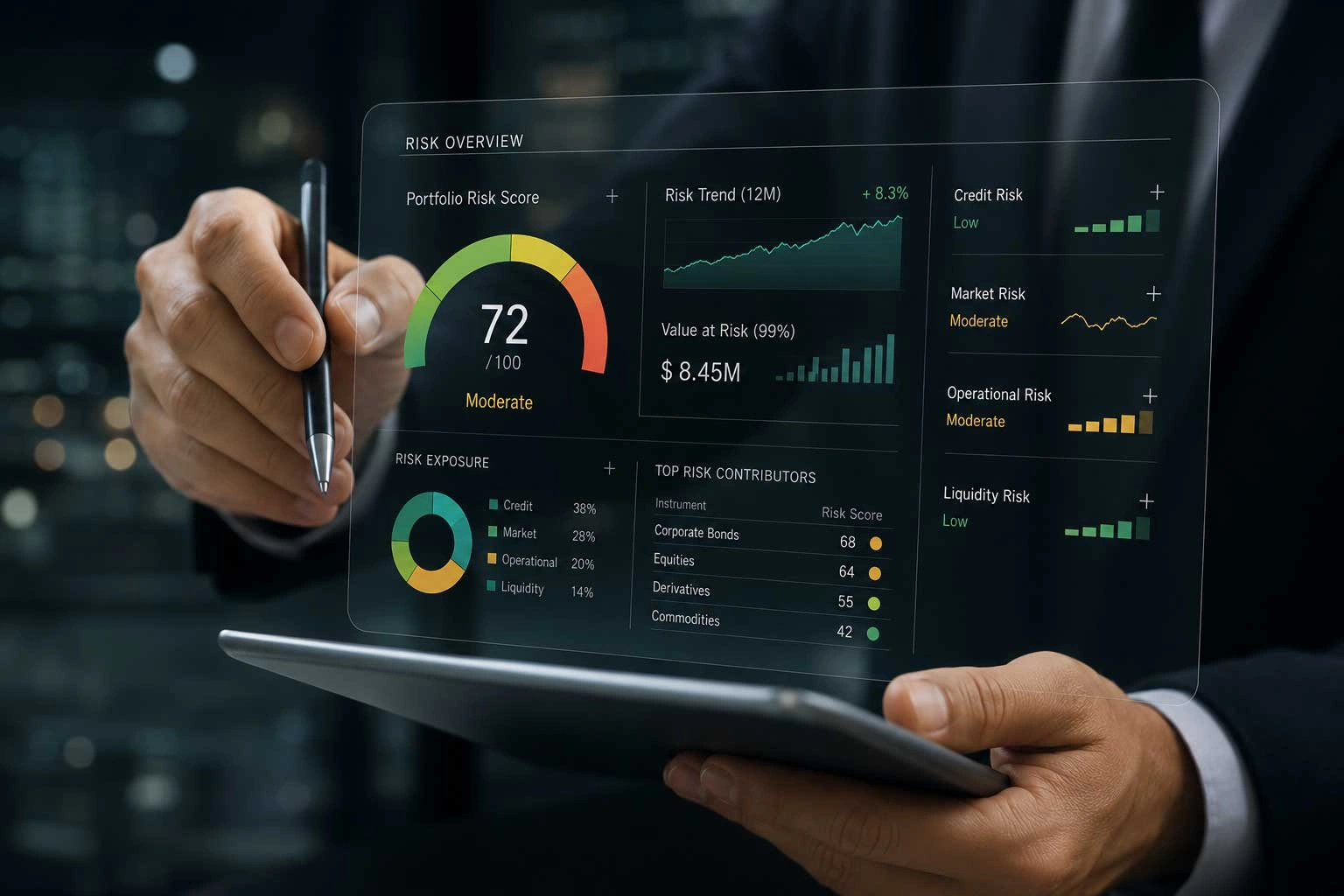
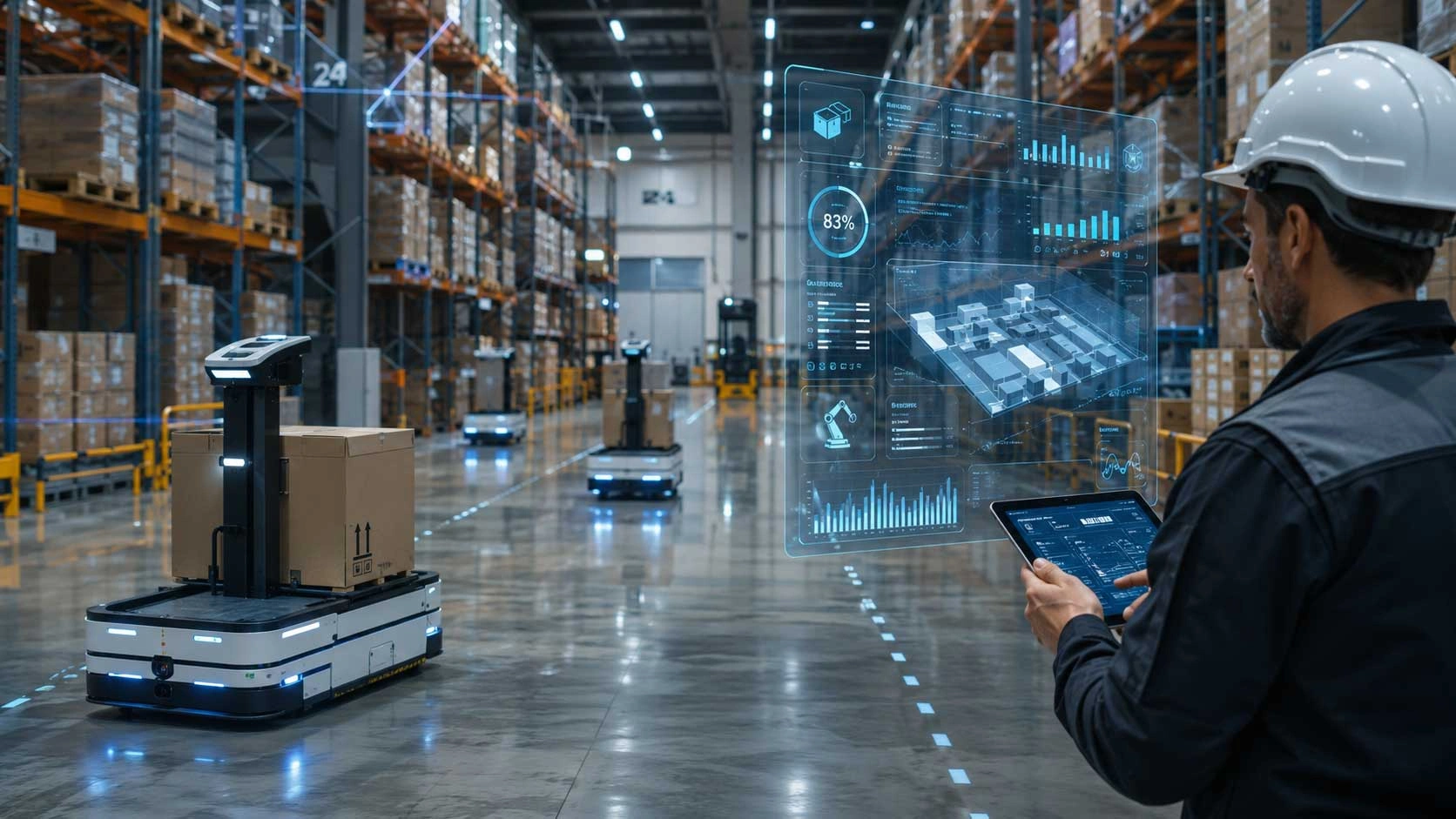


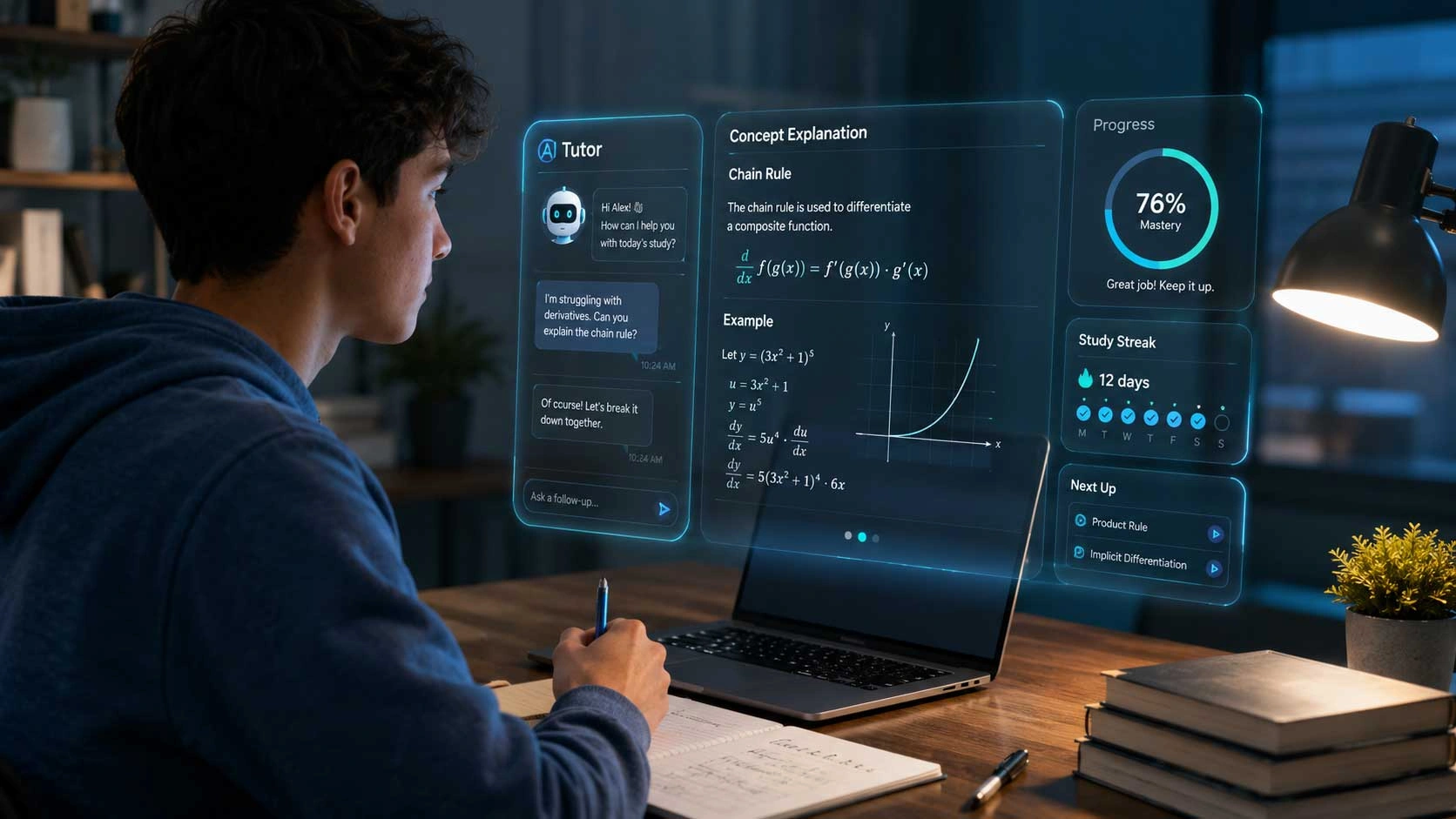
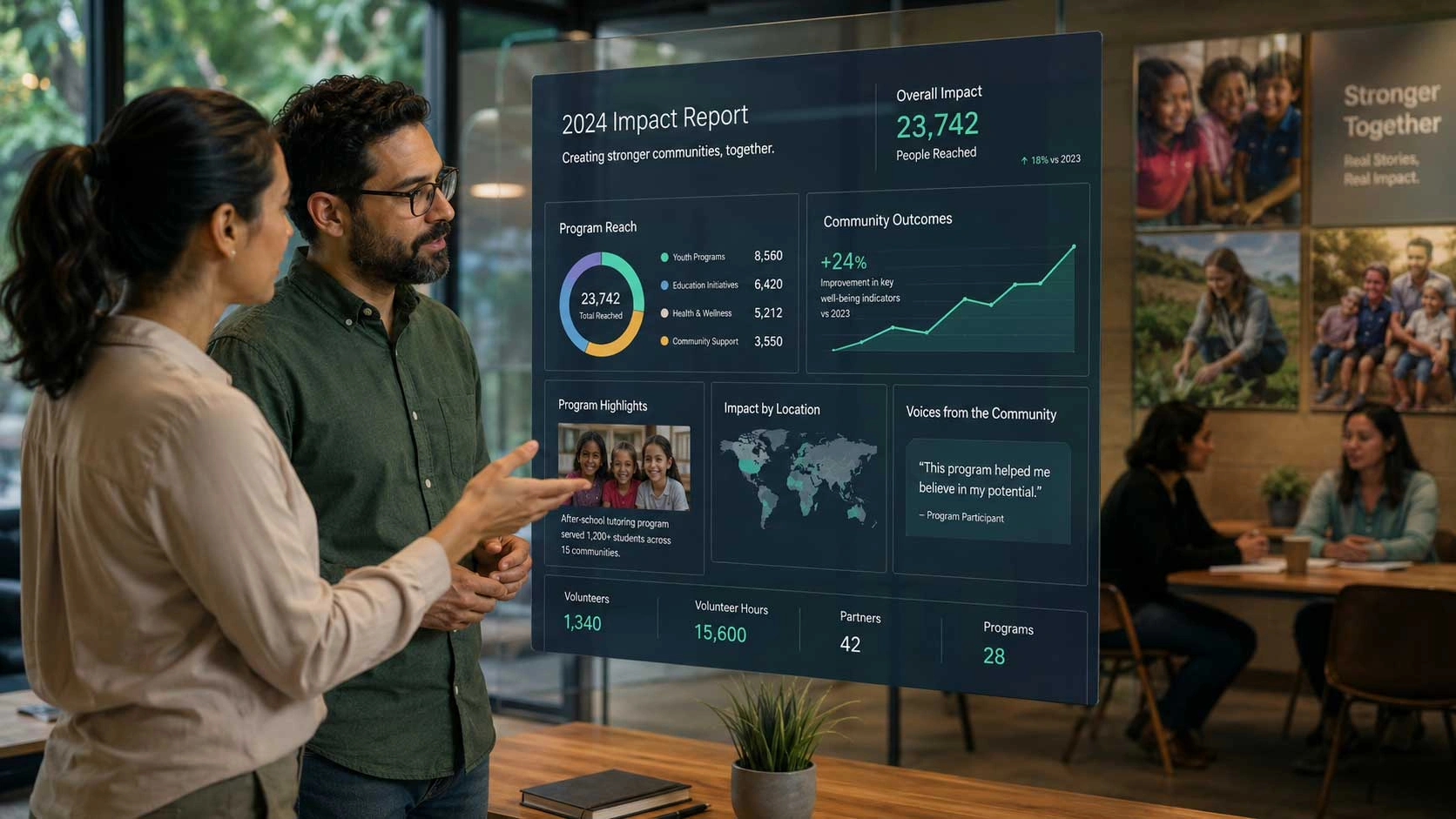
We combine deep AI expertise with enterprise delivery practices to ship production-ready intelligent systems.
Enterprise software delivery — a track record built across technology cycles, not just the current AI wave.

Independently certified, annually audited — meets the security baseline enterprise procurement actually checks.

Nine in ten enterprise clients return for follow-on work — the only measure of delivery quality that cannot be faked.

Verified client reviews, independently collected — real feedback from real enterprise engagements.

Certified cloud partnerships with AWS and Microsoft Azure — enterprise infrastructure standards from day one.

DataSense, DocSense, BidSense — proprietary pre-built AI products that go live in weeks, not months of custom build.
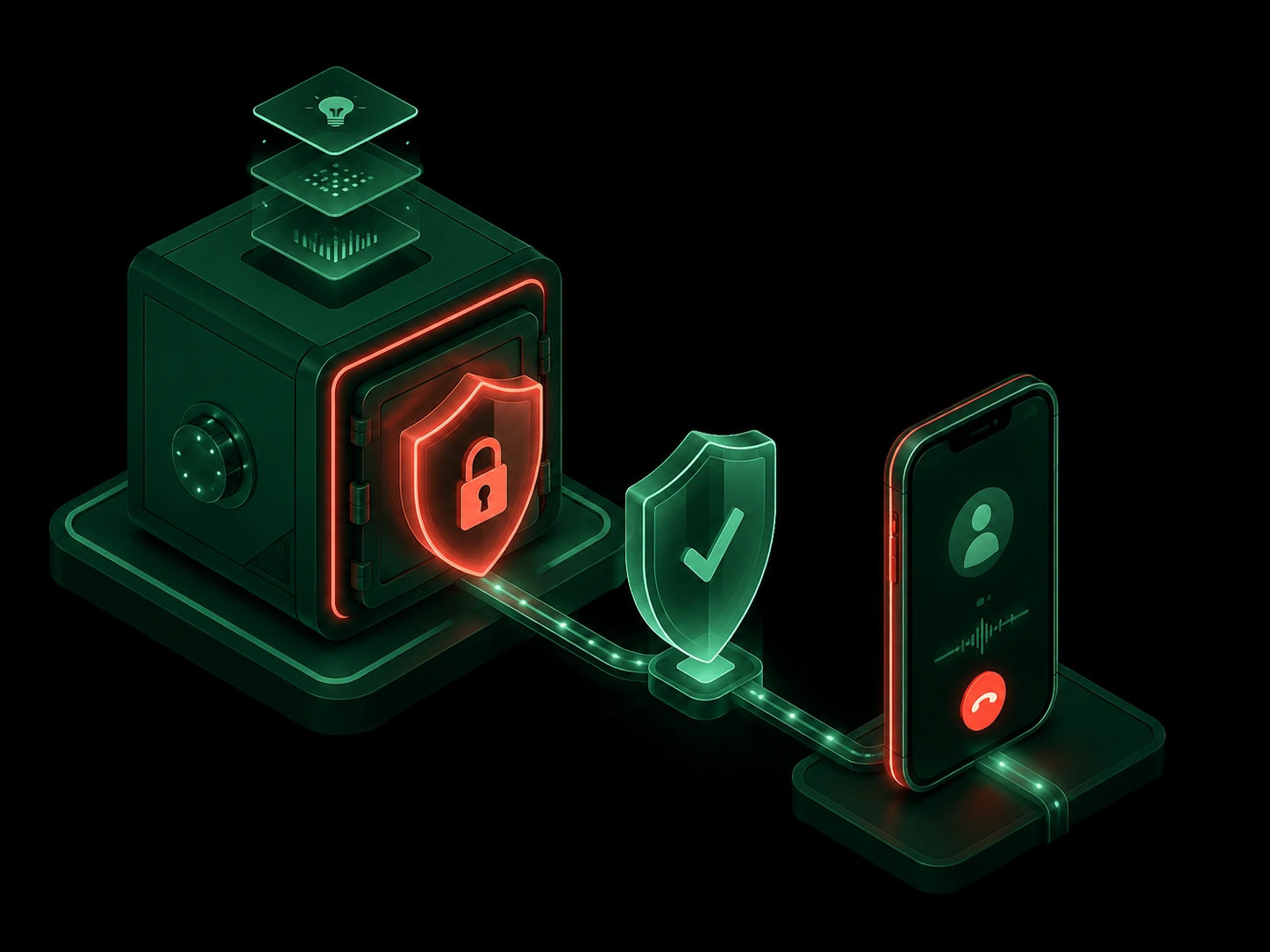
IP, data, and strategy protected before the first discovery call ends — not after contracts are signed.

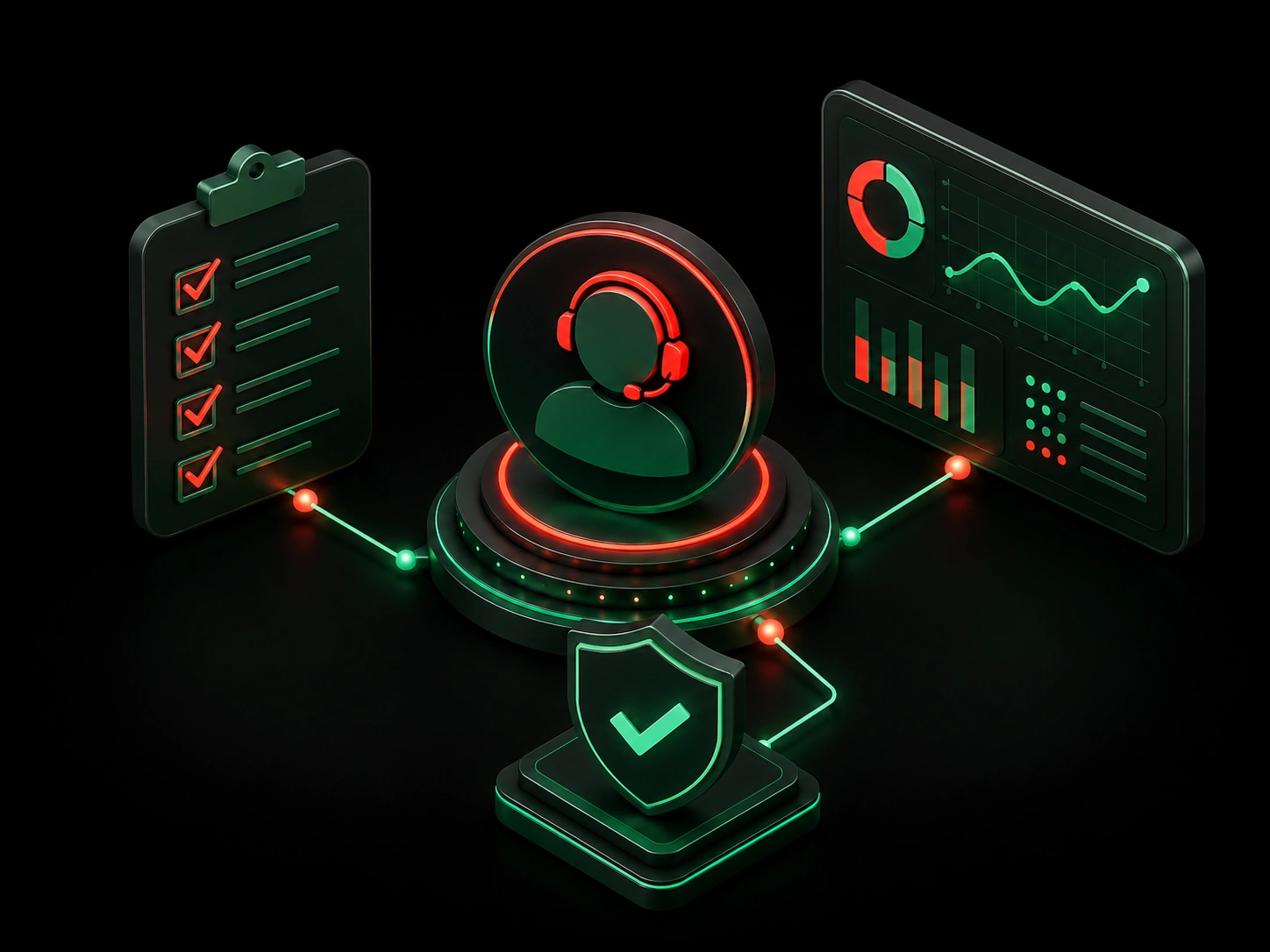
Post-deployment optimisation included in every engagement — we stay accountable until the system is performing.
 What does VOCSO's AI development process look like?
VOCSO follows a four-phase AI delivery process: Discovery & Strategy, Proof of Concept, Production Build, and Deployment & Iteration...
AI development is the practice of building software systems that perceive, reason, learn, and act on data in ways that used to require human judgment. In 2026, it has moved from experimental projects to a core business capability — and the gap between AI-enabled companies and the rest is widening every quarter.

AI is not a single technology. It is a family of techniques, and the right one depends on the problem you are solving:
The case for AI adoption in 2026 is no longer aspirational. It is a response to shifts in competition, customer behavior, and unit economics:
Not every AI problem needs a custom build. Knowing where custom engineering wins versus where SaaS is good enough is half the battle.
You have proprietary data that is a competitive moat, strict compliance or on-premise requirements, a workflow no SaaS handles end-to-end, or you need deep integration with multiple internal systems.
The use case is generic (meeting notes, generic support chat, sales email drafting), your data volume is low, you need to be live in weeks, or you want someone else to own model updates and compliance.
Key Takeaway: AI is no longer optional. Companies without an AI strategy are losing 15-30% productivity versus AI-enabled competitors, and the gap compounds quarter over quarter.
AI projects fail differently than traditional software projects. They fail because the data is worse than expected, the model does not generalize, or the business never defines what "good enough" looks like. Our four-phase methodology is designed to surface those risks early and turn them into decisions rather than surprises.
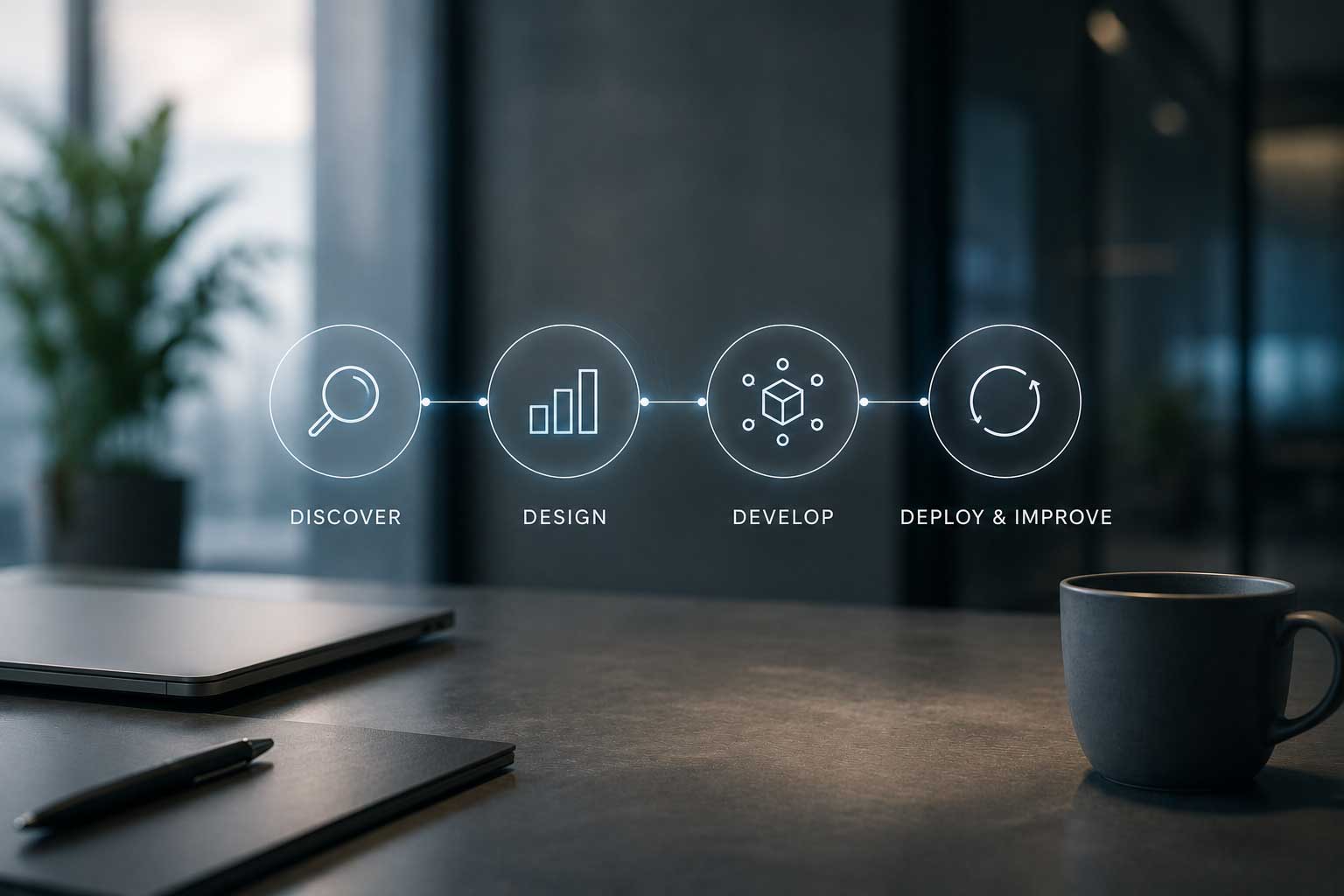
Every engagement starts with a focused discovery to separate real AI opportunities from "we heard we should do AI" projects.
Before we commit to a production build, we validate the core AI capability on real data in a tightly scoped PoC.
With a validated approach, we build production systems with the same engineering rigor we apply to non-AI software.
Launch is the start of the work, not the end. AI systems need active management to stay accurate as data and usage evolve.
Pro Tip: Start with a 6-week PoC before committing to full production. We help you de-risk AI investments with measurable validation — and we will tell you when an idea is not worth building.
The AI stack has consolidated in 2026 around a clear set of leading options at each layer. We are model-agnostic and tool-agnostic — our job is to recommend the right combination for your use case, not to steer you toward whatever we have pre-negotiated a discount on.
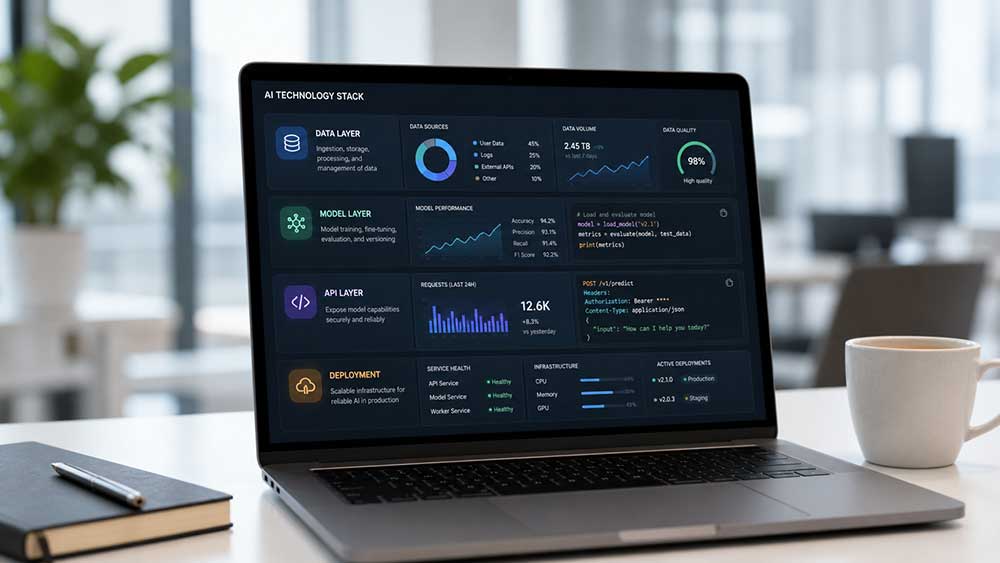
The LLM market has multiple strong players, each with real strengths. Here is how we choose:
| Model | Best For | Cost |
|---|---|---|
| GPT-4o | General purpose, broad knowledge, strong function calling | $$$ |
| Claude 4 | Long context (1M+ tokens), complex reasoning, careful analysis | $$$ |
| Llama 3 | Open source, self-hosted deployments, full data control | $ |
| Mistral | Cost-efficient inference, European data residency, multilingual | $$ |
| Gemini | Native multimodal (text, image, video), Google Cloud shops | $$ |
For RAG and semantic search, the vector database choice shapes retrieval quality and operational cost:
Fully managed, serverless scaling, zero ops burden. Best for teams that want to ship fast and not run infrastructure.
Open source with strong hybrid search (vector + keyword). Cloud or self-hosted. Good fit for complex retrieval patterns.
Rust-based, extremely fast, excellent for high-throughput workloads. Runs well on modest hardware.
PostgreSQL extension that keeps vectors alongside your relational data. Simplest choice for teams already running Postgres.
For custom training and classical ML, our default toolkit:
Pro Tip: We are model-agnostic. We recommend the right LLM for your use case, not whichever vendor pays us a kickback — and we will switch models if the landscape shifts after launch.
AI project costs vary more than traditional software because data readiness, accuracy targets, and compliance requirements can each shift the budget by 2-3x. The ranges below reflect realistic 2026 costs from projects we have shipped — not aspirational marketing numbers.
| Service | Price Range | Timeline |
|---|---|---|
| AI Chatbot | $20K - $80K | 6-12 weeks |
| RAG System | $40K - $150K | 8-16 weeks |
| Custom ML Model | $50K - $200K | 12-24 weeks |
| AI Agent System | $60K - $250K | 12-20 weeks |
| Enterprise AI Platform | $150K - $1M+ | 6-12 months |
These factors are the most common reasons budgets grow beyond initial estimates:
Key Takeaway: Most Gen AI projects come in at $40K-$120K. Enterprise platforms with deep integration run $200K+. We provide fixed-price quotes after a 1-week discovery phase — no open-ended T&M surprises.
The right AI playbook depends heavily on your company stage. A 50-person startup and a 50,000-person enterprise both need AI, but they do not need the same architecture, team structure, or rollout approach. We adapt our methodology to match — same engineering standards, different priorities.

Large organizations operate in a world of existing systems, established processes, and real compliance stakes. Our enterprise engagements emphasize:
Startups need to get to market and prove unit economics before anything else. Our startup engagements emphasize:
Deeper integrations, stronger governance, scale from day one, and compliance built into the architecture rather than retrofitted later.
Faster iteration, tighter focus, lower upfront cost, and the ability to change direction without a 20-person steering committee.
Pro Tip: We adapt our methodology to your stage. Same team, same quality bar — different playbook for a 50-person startup versus a 50,000-person enterprise.
Responsible AI is no longer a CSR talking point — it is a regulatory and operational requirement. The EU AI Act, evolving US state laws, and enterprise procurement checklists all require demonstrable governance. We build that in from day one rather than retrofitting it under audit pressure.

Every VOCSO AI project is designed against five principles that we treat as non-negotiable:
Our engineers have shipped under every major regulatory regime relevant to AI in 2026:
Bias does not get fixed by a single check at launch. We embed it throughout the lifecycle:
Key Takeaway: VOCSO's AI projects ship with built-in governance: audit logs, explainability dashboards, and human review workflows. Compliance is designed in, not retrofitted under audit pressure.
AI delivery is different from traditional software delivery because the output of model development is inherently probabilistic. Our team structure, communication cadence, and quality gates are designed around that reality — so you get predictable progress even when the model itself is still converging.

Every AI project is staffed with a cross-functional team sized to the scope. The four core roles:
Model design, training, evaluation, and prompt engineering. Own accuracy targets and iteration cycles against your success metrics.
Pipelines, ETL, warehousing, and feature stores. Own data quality and the flow from raw sources into model-ready inputs.
APIs, orchestration, caching, and scale. Own the production service layer that turns models into reliable product features.
Deployment, monitoring, CI/CD, and observability. Own uptime, cost, and the path from a trained model to production traffic.
You always know where the project stands without having to ask:
Pro Tip: Every VOCSO AI project includes a dedicated tech lead who is accountable end-to-end. No handoffs, no finger-pointing, one name on the escalation path.
There are hundreds of AI development firms in 2026, and most of them were founded in the last 18 months. VOCSO has been shipping production software since 2009 and AI systems for the last several years. Here is what that experience actually means for your project.
Production software delivered across industries since 2009, spanning web, mobile, AI, and enterprise platforms.
Independently audited information security management system covering our entire delivery organization.
Clients across North America, Europe, Asia, and the Middle East operating under diverse regulatory regimes.
Recognition for design and engineering quality on consumer-facing products.
We meet you where you are, with flexible commercial structures:
Ready to start?: Book a free 30-minute AI strategy call. We will review your use case, recommend an approach, and give you a clear next step — no sales pressure, no generic pitch deck.
Align on business goals, success metrics, and data readiness before any model is touched. This is where we sort signal from hype.
Strategy workshopsSuccess metric auditData readiness reviewRisk & compliance scanChoose the right architecture, model, and evaluation strategy — written down as a technical RFC the whole team can review.
System architectureModel & framework selectionEval harness designSecurity & data flowEngineering execution — model training/tuning, integrations, and continuous QA against the eval harness designed in phase two.
Model train / fine-tuneBackend integrationsEval-driven iterationSecurity auditProduction deployment, observability, and continuous optimization against live signals. The work doesn't end at launch.
Phased rolloutMLOps & monitoringDrift detectionOngoing optimizationProduction deployment, observability, and continuous optimization against live signals. The work doesn't end at launch.
Phased rolloutMLOps & monitoringDrift detectionOngoing optimizationBook a free 30-minute discovery call with a senior AI engineer — no slide deck, just questions about your stack.










Enabled users to retrieve operational, financial, and project insights through natural language queries, transforming complex data analysis into instant, self-service intelligence.
See case study
 <12 Seconds
  10+ Systems
  Days → Minutes
  95%+
95%+ This work became DataSense, our own conversational BI product. See how we build it for you in conversational BI development, or browse all our AI projects.
We select technology based on your workflow complexity, your security requirements, and your existing stack — not based on what we prefer to work with. Here is what we draw from.
Frameworks and automation engines for coordinating agents, tools, and workflows.
 LangGraph
 LangChain
 AutoGen
 CrewAI
State-of-the-art models for reasoning, generation, tool use, and enterprise AI workflows.
 Claude
 OpenAI GPT-4
 Google Gemini
 Mistral
 Cohere
Retrieval infrastructure for semantic search, document grounding, and knowledge-aware workflows.
 Pinecone
 Weaviate
 Qdrant
 Chroma
 Milvus
Short-term state, long-term memory, and context persistence for workflow-aware agents.
 Redis
Redis
 PostgreSQL
 LangMem
 Zep
Zep
Connect agents to tools, APIs, workflow triggers, and enterprise systems.
 MCP
MCP
 REST APIs
 GraphQL
 n8n
n8n
 Zapier
 Webhooks
Monitoring, tracing, evaluation, and performance visibility for production AI workflows.
LangSmith
 Langfuse
 OpenTelemetry
 Grafana
 Prometheus
Enterprise-grade cloud services and infrastructure foundations.
 AWS Bedrock
 Azure OpenAI
 GCP Vertex AI
 Docker
 Kubernetes
Modern development foundations for building custom workflow automation systems.
 Python
 TypeScript
 Node.js
 FastAPI
Enterprises trust VOCSO for AI consulting services built to scale securely and meet regulatory standards. We design enterprise-grade AI systems that balance innovation with compliance across AWS, Azure, and Google Cloud.

General Data Protection Regulation

Information Security Management Systems

System and Organization Controls

For AI applications in healthcare
Responsible AI principles and implementation
AI Risk Management

Principles and implementations

India’s personal data protection framework

Auditability frameworks

Standards and evaluation practices
Real ranges from our delivered projects. Your number depends mostly on data readiness and how deeply the system integrates with your tools, so every engagement starts with a free discovery call.
Validate feasibility on your real data and get a costed plan for the full build before you commit.
One production-ready capability, such as a RAG assistant, an AI agent or a forecasting model, deployed and integrated.
Data pipelines, MLOps, evaluation and monitoring: a system that holds up in production, not a notebook demo.
 Fixed-Price POC
Validate an AI use case with a low-risk engagement designed to prove value, feasibility, and ROI before a larger investment.
4–6 week delivery timeline Defined scope & success criteria Low commitment, fixed budget Executive-ready ROI assessment Dedicated AI Team
A cross-functional AI team embedded into your environment, working within your processes, security requirements, and delivery workflows.
AI, Data & MLOps specialists Named delivery lead Works within your NDA & security policies Scalable team composition Project-Based
End-to-end delivery of a defined AI capability with fixed scope, timeline, and commercial terms.
Fixed scope & pricing Defined milestones & deliverables Dedicated project management Knowledge transfer & documentationLet's discuss the right engagement model for your project?
Schedule a call
First-hand experiences from brands that scaled smarter, innovated faster, and achieved measurable growth with VOCSO.
View all client testimonials“Vocso team has really creative folks and is very co-operative to implement client project expectations. MicroSave Consulting had great experience working with Anju and Prem.”

“Working with Deepak and his team at Vocso is always a pleasure. They employ talented staff and deliver professional quality work every time.”

“We love how our website turned out! Thank you so much VOCSO Digital Agency for all your hard work and dedication.”

“VOCSO SEO & SEM services helped me find new customers in a small budget. Their advanced SEO strategies made us visible to everyone.”

“Vocso team has really creative folks and is very co-operative to implement client project expectations. MicroSave Consulting had great experience working with Anju and Prem.”
“Working with Deepak and his team at Vocso is always a pleasure. They employ talented staff and deliver professional quality work every time.”
“We love how our website turned out! Thank you so much VOCSO Digital Agency for all your hard work and dedication.”
“VOCSO SEO & SEM services helped me find new customers in a small budget. Their advanced SEO strategies made us visible to everyone.”
Most RAG systems fail in production not because RAG doesn't work — but because 80% of the engineering work was skipped to ship the demo faster.
RAG connects a language model to your live document store so answers are grounded in your actual data, not model memory. The demo is easy. Production is not.
Chunking strategy — How you split documents determines retrieval precision. Fixed chunks miss context. Semantic chunking adds complexity. We use hybrid strategies tuned per document type.
Vector store selection — Pinecone for cloud scale, Qdrant for on-premise sovereignty, pgvector for firms already on Postgres. The choice is made at architecture — not when problems surface.
Hybrid retrieval — Dense semantic search alone misses exact-match queries. We combine it with BM25 keyword retrieval and a cross-encoder re-ranker — cutting hallucination rates by 40–60% versus naive vector search.
Citation trails — Every answer surfaces its source document and page number. For regulated consulting environments, traceable outputs are non-negotiable.
At VOCSO, no RAG system ships without retrieval accuracy benchmarks run against a representative sample of real client queries.
Agentic AI is the most powerful class of AI we build — and the most likely to fail spectacularly if the architecture skips three problems that demos never surface.
Multi-agent systems let AI autonomously call tools, make decisions, and coordinate between specialised sub-agents. The engineering discipline required is fundamentally different from single-call LLM workflows.
State management — Agents need memory across turns. We use LangGraph's stateful graph model or custom Redis-backed stores — the choice depends on session length and latency requirements.
Tool reliability — Every tool an agent calls needs retry logic, timeout handling, and graceful degradation. One unreliable API makes the entire agent unreliable. This is where most POCs break in production.
Human-in-the-loop gates — Irreversible actions — sending emails, writing to production databases, executing transactions — always require an explicit human approval step on first deployment. Autonomy is earned incrementally.
Failure modes — We map every failure scenario before building: what does the agent do when a tool is down, a confidence threshold isn't met, or a loop is detected? Production agents need defined exits, not infinite retries.
VOCSO designs agent architectures for the failure cases, not the happy path — because enterprise clients cannot afford an agent that loops indefinitely at 2am.
Picking GPT-4o because it's the most famous model is like picking a Formula 1 car for a school run — impressive, expensive, and wrong for the job.
Model selection is one of the most consequential architecture decisions in any AI project, and it should never be made on brand recognition. We benchmark candidate models across four dimensions using client data.
Accuracy on your data — We build a curated evaluation set from representative real-world queries and gold-standard answers — then score each model against it. Synthetic benchmarks tell you nothing useful.
Cost per query — Context window usage, output token length, and expected request volume combine to produce a real monthly cost. A 10x price difference between models is common for identical quality on specific tasks.
Latency budget — P50 and P99 response times under realistic load. For real-time voice, agent chains, and interactive search, a 3-second response is a broken product, not a slow one.
Data sovereignty — Hosted APIs (OpenAI, Anthropic) require data to leave the client environment. Self-hosted models (Llama 3.1 70B, Mistral) keep it in. For regulated clients, this is the deciding factor.
GPT-4o leads on general reasoning. Claude 3.5 Sonnet leads on long-document tasks. Llama 3.1 70B is our default recommendation for air-gapped deployments. The right answer depends on your use case.
A proof of concept and a production system are different engineering problems. A POC answers 'does this work?' Production answers 'does this work for 500 users at 3am with no engineer watching?'
The graveyard of enterprise AI is full of impressive demos that never made it to production. The gaps are predictable — and preventable with the right architecture from the start.
Observability — Production AI needs structured logging of every prompt, response, latency, and token count. Print statements are not monitoring. You cannot fix what you cannot measure.
Prompt versioning — Prompts change in production. Without a versioning system, you cannot know which prompt is running, what changed, or what caused a quality regression.
Load handling — LLM APIs have rate limits. Without request queuing, backoff logic, and circuit breakers, your system degrades exactly when it matters most — under peak load.
Evaluation pipelines — Automated regression tests that catch quality degradation before users report it. Every model update, every prompt change, every retrieval config change needs a quality gate.
At VOCSO, we build observability, versioning, and evaluation pipelines before calling anything production-ready — because a system you cannot monitor is a system you cannot maintain.
The most underestimated part of any enterprise AI project isn't the model — it's getting your data from where it lives to where the AI can use it.
Enterprise data lives in SharePoint, Confluence, SQL databases, CRMs, ERP exports, and email archives. Each source requires a different extraction strategy. This is where most timelines slip.
Document ingestion — PDFs, Word, PowerPoint, and scanned images each require format-specific parsing. Layout-aware models (LayoutLM, Textract) outperform generic OCR on complex enterprise documents — tables, forms, multi-column layouts.
Structured data — SQL tables and CSVs can be vectorised as natural-language descriptions or served as direct tool-call targets for AI agents. The choice depends on query patterns and freshness requirements.
Real-time vs. batch — Knowledge assistants need fresh data. Batch nightly ingestion creates a knowledge lag that users notice. Webhook-triggered incremental updates keep the AI current without reprocessing the entire corpus.
Pipeline monitoring — Record counts, processing latency, failure rates, and index freshness are tracked as first-class metrics. A data pipeline with no monitoring is invisible when it silently breaks.
We design ingestion pipelines before touching the AI layer — because the best model in the world cannot rescue a broken data pipeline.
Traditional perimeter security assumes everything inside your network is safe. Zero Trust assumes nothing is — and for AI systems handling sensitive enterprise data, that assumption is the right one.
Zero Trust applied to AI means no user, no system, and no AI component receives implicit trust based on its location inside or outside the network. Every access is verified. Every action is logged.
Identity-first access — Every AI query is authenticated against your identity provider. Role-based access policies determine which documents a user can retrieve through the AI — the AI cannot return data the user is not already authorised to see.
Least-privilege data access — The AI system is granted the minimum data access required to perform its task. A knowledge assistant for the BD team cannot reach HR documents, even if they are in the same vector store.
Continuous verification — Session tokens are short-lived and re-validated. AI agent tool calls are authorised individually, not once at session start. Privilege escalation is blocked by architecture, not policy.
Full audit trail — Every query, every retrieved document, every AI output, and every tool call is logged with user identity, timestamp, and context. Audit logs are immutable and retained per your compliance requirements.
VOCSO designs Zero Trust AI architectures from the first sprint — not as a security retrofit after the system is built, which always costs more and leaves gaps.
Most teams default to 'just OCR it' — then discover that a table inside a PDF inside a SharePoint folder inside a zip archive requires five different extraction strategies, not one.
Enterprise document intelligence goes far beyond reading text off a page. Layout matters. Structure matters. The same string in a table header means something different from the same string in a footnote.
Layout-aware extractionModels like LayoutLM and Amazon Textract understand document structure — column positions, table relationships, form fields — producing structured outputs where naive OCR produces noise.
Multi-format pipelines Production document pipelines handle PDFs (native and scanned), Word, PowerPoint, Excel, images, and handwritten forms. Each requires a different processing path. We build unified pipelines that route by document type automatically.
Active learning loopsExtraction accuracy improves over time through active learning — the pipeline flags low-confidence extractions for human review, and those corrections re-enter model training. Accuracy compounds with usage.
Visual inspection AI For quality control, site inspection, and asset monitoring use cases, we build pipelines on YOLOv8, EfficientDet, and Vision Transformer architectures — with custom training on client-labelled data for domain-specific accuracy.
At VOCSO, document intelligence is engineered as a structured extraction problem — not an OCR job — which is why production accuracy significantly exceeds off-the-shelf tools on complex enterprise documents.
Voice-enabled AI is not 'add a microphone to your chatbot.' The latency budget for a natural voice interaction is under 1.5 seconds — end to end, including transcription, retrieval, generation, and speech synthesis.
Voice AI introduces hard real-time constraints that text-based AI never faces. Every component in the pipeline has an individual latency budget, and exceeding any one of them breaks the interaction.
Transcription model selectionWhisper Large v3 for high-accuracy batch transcription. Deepgram Nova-2 for real-time streaming at sub-300ms. AssemblyAI for speaker diarisation in multi-participant meeting recordings. The choice depends on latency vs. accuracy tradeoffs.
Meeting intelligenceReal-time transcription, automatic action item extraction, speaker attribution, and CRM update pipelines — turning every meeting into a structured record without manual note-taking.
Call analytics at scale Pattern extraction across large call libraries for compliance review, training insight, and QA scoring. Batch processing with LLM-powered classification and summarisation at thousands of hours of audio per day.
End-to-end pipeline latency STT + intent classification + RAG retrieval + LLM generation + TTS must complete in under 1.5 seconds. We architect each component with individual latency budgets and fallback paths for when any stage exceeds its limit.
VOCSO delivers voice AI as an integration into existing workflow tools — meeting platforms, CRMs, compliance systems — not as a standalone interface that teams have to adopt separately.
Not every AI workload should go to a cloud API. Sometimes the data cannot leave the building. Sometimes 500ms of latency is a broken product. Sometimes there is no internet connection at all.
Edge AI runs AI inference on local devices — tablets, inspection terminals, on-premise servers, IoT sensors — rather than sending data to a cloud API. Three enterprise scenarios make it the right choice.
Data sovereigntyDefence-adjacent consultancies, regulated financial data, and client-confidential project work often cannot leave the client's infrastructure. Self-hosted models (Llama 3.1, Mistral) run fully on-premise with no cloud dependency.
Latency-critical applicationsQuality inspection on a production line, real-time field data analysis, and sub-100ms inference requirements make cloud round-trips unacceptable. Edge inference eliminates network latency from the critical path.
Model compression for deployment We use quantisation (INT8, INT4), pruning, and knowledge distillation to reduce multi-gigabyte models to sizes deployable on constrained hardware without unacceptable accuracy loss. ONNX Runtime and TensorRT for optimised inference.
Local-vs-cloud boundary design Not all tasks need to run on-device. We design hybrid architectures where privacy-sensitive and latency-critical operations run locally, while non-sensitive high-complexity reasoning offloads to cloud models when connectivity allows.
At VOCSO, the edge-vs-cloud decision is made use-case by use-case at the architecture phase — we do not default to cloud because it is easier, or to edge because it sounds more secure.
You delivered exactly what you said you would in exactly the budget and in exactly the timeline.






 Transparency on every decision Talented Team of AI Engineers Smooth Collaboration & Reporting Efficient & Adaptive Workflow Strict Privacy Assurance with NDA 12 Months Free Post-Launch Support On-time Delivery, No Surprises ISO 27001 Certified Engineering
We help businesses design and develop production-ready AI applications — from LLM-powered tools and RAG systems to copilots, automation workflows, and custom AI platforms. Clear scope, practical delivery, measurable outcomes.
deepak@vocso.com — no forms, no funnels.
We build a comprehensive range of AI solutions across the entire intelligence spectrum. Our portfolio includes generative AI applications powered by LLMs like GPT-4 and Claude, retrieval-augmented generation (RAG) pipelines for knowledge-grounded Q&A, AI chatbots and autonomous agents for customer support and workflow automation, machine learning models for prediction, classification, and recommendation, computer vision systems for image recognition and quality inspection, NLP solutions for document processing and sentiment analysis, and custom AI integrations that embed intelligence into existing enterprise software. Each solution is architected for production reliability with monitoring, scaling, and maintenance built in from day one.
AI development costs vary based on complexity, data requirements, and scope. A simple AI chatbot integration starts around $20,000, a RAG system with enterprise features ranges from $40,000 to $150,000, and custom ML model development can range from $50,000 to $200,000 or more. The primary cost factors include data readiness (clean data reduces preparation costs), the number of integrations required, accuracy requirements (higher thresholds need more iteration), compliance and security needs, and ongoing infrastructure costs for hosting and API usage. We provide detailed estimates with a clear breakdown of one-time development costs versus ongoing operational costs after an initial discovery session, so there are never surprises post-launch.
Timelines depend on the project scope and complexity. An AI chatbot or simple RAG implementation can be prototyped in 2-3 weeks and production-ready in 6-8 weeks. Custom ML model development typically takes 8-16 weeks including data preparation, training, evaluation, and deployment. Enterprise-scale AI platforms with multiple integrations and compliance requirements may take 3-6 months. We use an agile sprint-based approach with bi-weekly demos, so you see working progress every two weeks. Our rapid prototyping phase validates feasibility before committing to full development, which de-risks the timeline and ensures we are building the right solution.
Absolutely. Integration with existing systems is one of our core strengths. Whether your data lives in SQL databases like PostgreSQL or MySQL, cloud storage like AWS S3 or Azure Blob, CRMs like Salesforce or HubSpot, document management systems like SharePoint or Confluence, or custom internal tools, we build connectors and pipelines to leverage it effectively. Our integration approach uses well-designed APIs and event-driven architectures that add AI capabilities to your existing workflows without disrupting current operations. We have integrated AI with over 50 different enterprise platforms and can typically connect to any system that provides an API or database access.
Security is foundational to our AI development practice, not an afterthought. We are ISO 27001 certified, meaning we follow internationally audited information security practices. Specific measures include encrypted data pipelines for data in transit and at rest, role-based access control with the principle of least privilege, secure model serving infrastructure within your private cloud or VPC, comprehensive audit trails for all data access and model predictions, regular security assessments and penetration testing, and data processing agreements with all third-party AI providers. For regulated industries, we design AI systems that meet HIPAA, GDPR, PCI-DSS, and SOC 2 requirements from the architecture phase rather than adding compliance retroactively.
We maintain expertise across the full AI technology landscape and recommend tools based on your specific requirements rather than defaulting to a single vendor. For large language models, we work with OpenAI GPT-4, Anthropic Claude, Meta Llama 3, Mistral, Google Gemini, and Cohere. For orchestration, we use LangChain, LlamaIndex, Semantic Kernel, and Haystack. For vector databases, we deploy Pinecone, Weaviate, Qdrant, ChromaDB, and pgvector. For traditional ML, we use PyTorch, TensorFlow, scikit-learn, and XGBoost. Our model selection process considers accuracy, cost, latency, privacy requirements, and vendor lock-in risks to ensure you get the optimal technology stack for your use case.
Yes, fine-tuning is one of our core capabilities. We fine-tune both open-source models like Llama 3 and Mistral, which can be hosted entirely within your infrastructure, and proprietary models through OpenAI and Anthropic fine-tuning APIs. Fine-tuning improves accuracy for domain-specific tasks by teaching the model the language, patterns, and knowledge unique to your industry. It can also reduce inference costs by 50-70% because a fine-tuned smaller model often outperforms a larger general-purpose model on your specific task. We handle the entire fine-tuning process including training data curation, hyperparameter optimization, evaluation against benchmarks, and deployment of the fine-tuned model.
Our process follows five structured phases. Discovery and Strategy involves stakeholder interviews, data audits, use case prioritization, and roadmap creation. Data Preparation covers data cleaning, labeling, transformation, and pipeline automation. Model Development includes rapid prototyping, systematic experimentation, benchmarking, and model selection. Integration and Deployment handles containerized deployment, API design, CI/CD pipelines, and infrastructure configuration. Monitoring and Optimization provides ongoing performance tracking, drift detection, automated retraining, and continuous improvement. We use agile sprints with bi-weekly demos so you have visibility into progress at every stage, and each milestone delivers independently deployable value.
Yes, AI systems require ongoing attention to maintain their effectiveness, and we offer comprehensive post-deployment support packages. Our maintenance services include continuous model performance monitoring with automated alerting, data drift detection and scheduled model retraining to maintain accuracy, bug fixes and incident response with defined SLAs, feature enhancements and capability expansion, infrastructure optimization to manage hosting costs as usage grows, and regular reporting on AI system performance and ROI metrics. Most clients choose a monthly retainer that includes a defined number of support hours, monitoring, and one model retraining cycle per quarter. This ensures your AI solution stays accurate and effective as your data and business needs evolve.
Yes, our AI consulting services are specifically designed for organizations that want to identify the highest-impact AI use cases before committing development resources. Our strategic engagement includes a comprehensive assessment of your data maturity and readiness, identification and prioritization of AI use cases ranked by business impact and feasibility, competitive analysis showing how peers in your industry are using AI, technology landscape evaluation with vendor-neutral recommendations, ROI estimation for each proposed AI initiative, and a phased implementation roadmap with resource requirements and timeline estimates. This consulting phase typically takes 2-4 weeks and produces a detailed report that serves as the foundation for informed AI investment decisions.
RAG (retrieval-augmented generation) and fine-tuning are complementary techniques that serve different purposes. RAG works by retrieving relevant documents from your knowledge base at query time and providing them as context to the LLM. It excels when you need responses grounded in specific, frequently updated data and when source attribution is important. Fine-tuning permanently modifies the model weights using your training data, teaching it new behaviors, domain-specific language, or specialized knowledge. Fine-tuning is better for tasks that require a consistent style or format, domain-specific terminology, or when you need to reduce inference costs by using a smaller fine-tuned model. In many projects, we combine both approaches: fine-tuning the model for domain-specific language and behavior, then using RAG to provide real-time access to current information.
AI hallucinations, where a model generates plausible-sounding but incorrect information, are one of the biggest challenges in deploying LLM-based systems. We use a multi-layered approach to minimize hallucinations. First, we implement retrieval-augmented generation (RAG) to ground every response in verified source documents, so the model references real data rather than generating from its training knowledge. Second, we design structured prompts with explicit instructions that constrain the model to answer only based on provided context and to say "I don't know" when information is insufficient. Third, we add output validation layers that check responses for factual consistency against the retrieved sources. Fourth, we implement confidence scoring that flags low-confidence responses for human review. Finally, for high-stakes applications, we build human-in-the-loop workflows where critical AI outputs are reviewed by subject matter experts before being presented to end users.
Absolutely, and we strongly recommend a phased approach for most AI initiatives. Phased development reduces risk, delivers value incrementally, and allows you to learn from real-world usage before investing in more advanced capabilities. A typical phased approach starts with Phase 1, an MVP that proves the core AI capability works with your data and delivers measurable value, usually in 6-8 weeks. Phase 2 expands the solution with additional data sources, more sophisticated retrieval or prediction capabilities, and deeper integrations, typically 6-10 weeks. Phase 3 adds enterprise features like role-based access, multi-language support, advanced analytics, and compliance controls. Each phase is scoped to deliver independently useful functionality, so you get production value at every stage rather than waiting months for a big-bang launch.
Yes, we offer flexible engagement models including dedicated AI development teams. A dedicated team typically includes an AI/ML engineer, a data engineer, a backend developer, and a project manager, with additional roles like DevOps engineers or QA specialists added as needed. Dedicated teams work exclusively on your project, providing deep context, faster iteration, and more predictable delivery. This model is ideal for organizations with ongoing AI development needs, multiple AI initiatives running in parallel, or complex projects that require consistent team continuity over several months. We also offer staff augmentation where individual AI engineers join your existing team, and fixed-price project-based engagements for well-defined AI initiatives with clear scope.
We have delivered AI solutions across 15+ industry verticals, with the deepest experience in healthcare (clinical decision support, medical coding, patient risk prediction), fintech (fraud detection, credit scoring, compliance automation), e-commerce (recommendation engines, dynamic pricing, visual search), SaaS (intelligent features, automated workflows, predictive analytics), education (adaptive learning, automated grading, student analytics), and legal (document review, contract analysis, research automation). Our cross-industry experience is actually a significant advantage because many AI patterns transfer between domains. A recommendation engine built for e-commerce shares architectural patterns with a content suggestion system for media. Our engineers bring this cross-pollination of ideas to every project, often applying proven techniques from one industry to solve novel challenges in another.
Most consulting firm engagements start with a fixed-price AI Discovery Sprint — a two-week engagement where we map your highest-value use cases, assess your data readiness, and produce a sequenced roadmap with ROI estimates.
The output is a concrete brief your leadership team can present internally to build the business case for a full programme. It requires minimal commitment and delivers a clear picture of where AI can move the needle in the next 90 days.
A VOCSO AI proof of concept runs 4–6 weeks with a fixed scope and fixed budget, typically between $15,000 and $40,000 USD depending on data complexity and integration requirements.
We define measurable success criteria before any work begins — so there are no surprises about what 'done' looks like. This structure is designed for firms that need to demonstrate ROI to leadership before committing to a full programme.
All intellectual property is fully and unconditionally owned by you. We execute NDAs before any discovery call, and client data is never used to train shared models.
For firms with stricter requirements — financial services, legal, defence-adjacent consulting — we support private-cloud deployment, on-premise hosting, VPN-only access, and data residency in your preferred geography. Our ISO 27001 certification covers the entire development and delivery process.
RAG (Retrieval-Augmented Generation) connects a language model to your document store in real time. The model reasons over your content without being trained on it — fast to deploy, easy to update, and safe for regulated data.
Fine-tuning permanently adapts a model's weights using your domain data, improving tone, terminology, and task-specific accuracy. For most consulting firms, RAG is the right starting point. Fine-tuning becomes valuable once you have identified specific accuracy gaps that RAG cannot close.
Yes — we connect AI systems to Salesforce, HubSpot, SAP, Oracle, Microsoft Dynamics, Jira, Monday.com, SharePoint, and most platforms with a REST API.
AI that works inside the tools your teams already use gets adopted. AI that requires a new interface does not. Every VOCSO engagement includes an integration design phase before the build begins.
The two highest-ROI entry points are DocSense and BidSense from the VocsoAI suite. DocSense makes your methodology library, project archives, and proposal templates searchable in natural language — so consultants stop re-inventing content that already exists. BidSense automates bid qualification and compliance matrix drafting — saving senior time on tenders that should never have been pursued.
Both deploy in 4–6 weeks with measurable results in the first sprint.
We are model-agnostic by design. We evaluate GPT-4o, Claude 3.5, Gemini Pro, Llama 3, and Mistral against your use case, data sensitivity, and cost targets.
For some applications a hosted API model gives the best accuracy. For others, a self-hosted open-source model is the right choice for cost, latency, or data sovereignty. We benchmark on your actual data — not synthetic test sets — before making a recommendation.
Discover complementary services that enhance performance, improve user experience, and help your business build scalable digital solutions efficiently.