Generative AI built by an engineering team shipping software since 2009


VOCSO builds generative AI applications for businesses: copilots, content and document generation, image generation and RAG-backed assistants on GPT, Claude, Gemini or open models. A fixed-price pilot costs $12K–$20K over about 6 weeks; production apps typically cost $20K–$60K. We built Spacebot AI, a room-makeover image generator, for The Civil Company.

 Reviewed by Deepak Chauhan, Founder & CEOLast updated












Generative AI built by an engineering team shipping software since 2009

Assistants embedded in your CRM, helpdesk, intranet or product that draft, summarise and suggest next steps for review.

Product descriptions, marketing copy, reports and emails generated to your style guide, with approval workflows before publishing.

Turn briefs, transcripts and data into proposals, contracts, summaries and structured documents from your templates.

Guided image generation inside your app, such as the Spacebot AI room-makeover tool we built for The Civil Company.

Assistants that answer from your documents and databases with citations, so output is grounded in your data.

Customer and employee chat interfaces with memory, escalation to people and full conversation logs.

Add generation, summarisation or smart search to an existing web app, SaaS product or internal tool through secure APIs.

Benchmark models on your examples and fine-tune only when prompting and retrieval cannot reach the quality bar.

Versioned prompts, test sets from real examples and output checks that run before every release.

When generated output must trigger actions in other systems, we extend the app into a governed agent or workflow.

Common generative AI applications we design, build and run in production.

Grounded answers for customers and employees, with escalation to a person.

Product, marketing and support content produced to your style guide.

Long reports, contracts and transcripts condensed into structured summaries.

Natural-language search over your documents with cited answers.

Replies, follow-ups and account notes drafted inside your CRM for review.
Guided generation of product, interior and marketing visuals inside your app.

Context-aware translation that keeps your terminology consistent.

Upload a file and ask questions, with answers linked to the exact passage.

Transcribe and index recordings so teams can search and query them.
Ranges from our delivered projects. Generative AI cost depends mostly on evaluation work, integration depth and per-use running cost, so every engagement starts with a free discovery call. Minimum engagement is $10K.
Validate feasibility on your real data and get a costed plan for the full build before you commit.
One production generative AI capability, such as a copilot, a document generator or a RAG assistant, deployed and integrated.
Data pipelines, MLOps, evaluation and monitoring: a system that holds up in production, not a notebook demo.
 Dedicated Generative AI Team
A dedicated team of generative AI engineers working on your roadmap full time, billed monthly, with a named lead.
 160 Hours of full time No Hidden costs Monthly Billing Dedicated account manager Seamless communication Transparent tracking & reporting
 Fixed Cost
Fixed price for a clearly defined scope, such as a pilot or one production capability, with milestones and acceptance criteria.
Budget predictability Well-defined scope Cost efficiency Milestone-based progress Quality assurance Transparent reporting Seamless communication Time & Resources Based (Pay As You Go)
Pay for the hours our generative AI engineers actually spend, for evolving scope or ongoing improvement work.
Flexible billing Agile adaptability Efficient resource use Transparency Ongoing communication No fixed commitment Transparent tracking & reportingNot sure which engagement model fits your project?
Schedule a call


Production AI we have built, with outcomes taken from the published case studies.











The Civil Company is a construction and interiors marketplace for Delhi NCR. We built Spacebot AI, which turns a photo of a room into a realistic AI-generated makeover. A guided prompt builder (room, style, palette and budget) sits in front of a generative image API, so non-technical users get consistent results without writing prompts. The wider platform has onboarded 3,979 vendors across 24 categories in 6 cities.

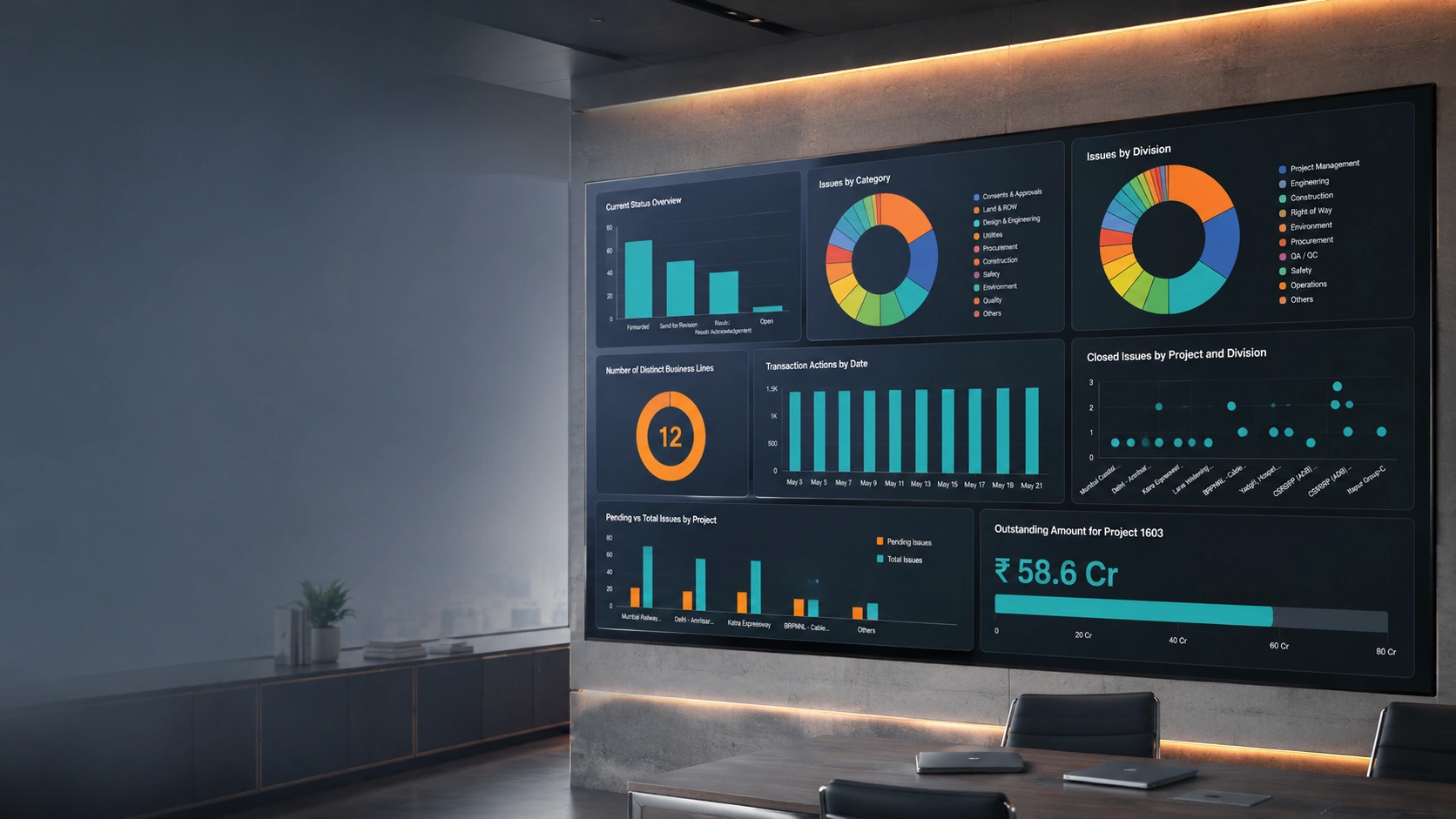

Non-technical users ask business questions in plain English. An LLM-based engine applies business rules, generates and validates SQL against enterprise databases, and returns a chart, a written insight and an Excel export for every answer. The pilot answered 739 natural-language queries.

"Vocso team has really creative folks and is very co-operative to implement client project expectations. MicroSave Consulting had great experience working with Anju and Prem."

"Working with Deepak and his team at Vocso is always a pleasure. They employ talented staff and deliver professional quality work every time."


"It was an amazing experience working with the VOCSO team. They were all so creative, innovative, and helpful! The finished product is great as well - I couldn't have done it without them"


Agree the use case, the success metric and the examples that define good output.

A working prototype on your data, with candidate models compared side by side.

Make output quality measurable and safe before scaling.

Build the app and connect it to the systems your team uses.

Roll out in stages and improve from real usage.
Want to see how this process fits your use case?
Schedule a callThese are three ways to get useful output from a language model, and most production apps combine at least two.
| Approach | What it does | Best for | Watch out for |
|---|---|---|---|
| Generative AI (prompting) | The model writes from its training plus your instructions | Drafting, rewriting, summarising, ideation | Facts it does not know; needs output checks |
| RAG | Retrieves your documents at query time and answers from them | Answers that must match your current data, with citations | Retrieval quality decides answer quality |
| Fine-tuning | Adjusts model weights on your examples | Fixed formats, house style, domain terminology, lower cost per call | Needs clean training data; does not add fresh facts |
VOCSO's take: Start with prompting plus RAG. Fine-tune only when an evaluation shows a specific gap that retrieval and prompting cannot close. See RAG development services and LLM fine-tuning services.
The best first projects are frequent, text-heavy tasks where a person reviews the output anyway.
| Function | Generative AI application | What to measure |
|---|---|---|
| Sales | Proposal and email drafting from CRM data | Time to first draft |
| Marketing | Product descriptions and campaign variants to a style guide | Pieces produced per week, edit rate |
| Support | Suggested replies grounded in the help centre | Handle time, escalation rate |
| Operations | Report and summary generation from records | Hours spent on reporting |
| Product | In-app copilots and image generation features | Feature adoption, retention |
| Legal & compliance | Clause comparison and first-pass document review | Review time, issues caught |
If the task also needs actions in other systems, consider AI agent development or agentic workflow automation.
Generated output is probabilistic, so quality has to be measured, not assumed.
Golden examples — A test set of real inputs with approved outputs, built with your team during discovery.
Automated checks — Format, length, banned terms, citation presence and factual consistency against sources.
Model-graded review — A second model scores relevance and tone against a rubric, spot-checked by people.
Human review loop — Reviewer edits are logged and fed back into prompts and test sets.
Rule: No prompt, model or retrieval change reaches production without re-running the evaluation set.
Each model family trades off quality, cost, latency and data control. We benchmark on your examples rather than public leaderboards.
OpenAI GPT models — Strong general-purpose generation and tool use, broad ecosystem.
Anthropic Claude — Long documents, careful writing and analysis.
Google Gemini — Multimodal input and Google Cloud environments.
Open-weight models (Llama, Mistral) — Self-hosted deployments, full data control, lower cost at volume.
Image models — Chosen per use case for realism, style control and licensing terms.
Model selection, serving and fine-tuning in depth are covered on our LLM development services page.
Generative AI apps often handle customer and business data, so controls are designed in from the start.
PII and sensitive fields are masked or removed before they reach a model API.
Private cloud or self-hosted models where compliance requires it (for example HIPAA or GDPR obligations).
Encryption in transit and at rest, and API keys scoped per service.
Prompt and output logging with user identity.
Source citations for RAG answers.
Human approval for high-risk actions such as sending emails or publishing content.
VOCSO's delivery process is certified to ISO/IEC 27001. For organisation-wide governance, see enterprise AI development.
Summaries of unstructured reports
First drafts of compliance documentation
Customer correspondence drafting
Clinical note and document summarisation
Claims document processing
Patient communication drafts reviewed by staff
Product descriptions and attributes
Personalised email content
Visual merchandising images
AI room and interior visualisation, as in our Spacebot AI build
Listing descriptions
Clause comparison and first-pass review
Proposal and RFP drafting
Research summaries
Course material summaries
Practice questions and feedback
Tutor assistants for student questions
You delivered exactly what you said you would in exactly the budget and in exactly the timeline.





 Transparency on every decision Talented Team of AI Engineers Smooth Collaboration & Reporting Efficient & Adaptive Workflow Strict Privacy Assurance with NDA 12 Months Free Post-Launch Support On-time Delivery, No Surprises ISO 27001 Certified Engineering
Generative AI development services cover building applications that create text, summaries, documents, code or images for your business. At VOCSO that includes use-case selection, model benchmarking, prompt and retrieval design, an evaluation set built from your real examples, output guardrails, the user interface or integration into your existing tools, deployment and monitoring. Typical builds are copilots, content and document generators, image generation features and RAG-backed assistants. Model-level work such as fine-tuning and self-hosted serving is covered by our LLM development services.
A fixed-price generative AI pilot costs $12K–$20K and takes about 6 weeks. One production capability, such as a copilot, a document generator or a RAG assistant, typically costs $20K–$60K over 8–12 weeks. A full system with data pipelines, evaluation, monitoring and several integrations runs $60K–$150K+. Our minimum engagement is $10K. Beyond the build, budget for per-use model costs and about 15–25% of the build cost per year for hosting, monitoring and updates. The AI development cost guide explains each driver.
A pilot takes about 6 weeks and a focused production app 8–12 weeks. The cost guide puts generative AI in-product features at roughly 6–14 weeks, depending on evaluation work, UX iterations and integrations. The first two weeks agree the use case, the examples that define good output and the success metric. Apps that must integrate with several systems, meet strict compliance requirements or run on self-hosted models take longer. You see a working prototype within the first weeks, so quality and cost are measured before the full build.
Generative AI development focuses on the application: what users do with generated output, how it fits their workflow and how quality is checked. LLM development focuses on the model layer: choosing, evaluating, fine-tuning, hosting and serving the large language model itself. Most generative AI apps use a hosted model through an API and never need model-level work. When a project needs a fine-tuned or self-hosted model, our LLM development services team handles that layer and the generative AI team builds the product on top.
Start with RAG in most cases. Retrieval-augmented generation answers from your current documents with citations, is quick to update and keeps proprietary data out of model training. Fine-tuning changes the model itself and suits fixed output formats, house style or specialist terminology, or cutting cost per call at high volume, but it does not add fresh facts. We fine-tune only when an evaluation shows a gap that prompting and retrieval cannot close. See RAG development services and LLM fine-tuning services.
Yes. Many of our generative AI projects add features to an existing web app, SaaS product, CRM or internal tool rather than building a new one. We connect to models through secure APIs, add retrieval over your data where needed, and surface the feature where users already work, such as a panel in your app, a CRM sidebar or a Teams bot. Usage, cost and quality are logged from day one. Our AI integration services page covers integration patterns for common platforms.
We mask PII and sensitive fields before data reaches a model API, use private cloud or self-hosted open-weight models when data cannot leave your environment, encrypt data in transit and at rest, and log prompts and outputs with user identity. Client data is never used to train models for other clients, and you own all code, prompts and outputs. VOCSO's delivery process is certified to ISO/IEC 27001. For regulated sectors we map GDPR, HIPAA or SOC 2 obligations to concrete controls during discovery.
We are model-agnostic. For text we typically benchmark OpenAI GPT models, Anthropic Claude and Google Gemini, plus open-weight models such as Llama and Mistral for self-hosted deployments. For images we pick a generation API per use case based on realism, style control and licensing. We compare candidates on your real examples for quality, latency and cost per request, and keep the model swappable so you can change provider later without rebuilding. Orchestration usually uses LangChain, LlamaIndex or LangGraph.

Certified, partnered and independently rated



 Faster first drafts
 Consistent tone and format
 Answers from your own data
 Personalisation at scale
 Less manual document work
 Visual content on demand
 Measured quality
 Controlled running cost
 Data stays protected
