
Table of Contents
RAG Development
Retrieval-Augmented Generation for grounded enterprise AI
- ✔️ Combines internal knowledge base with LLM
- ✔️ Reduces hallucinations, boosts trust
- ✔️ Powered by vector search + embeddings
- ✔️ Perfect for enterprise documentation, SOPs

Table of Contents
Introduction
Operational complexity inside modern businesses has increased dramatically over the last few years.
Teams today are expected to move faster, manage more systems, process larger volumes of information, support distributed operations, and make decisions in near real-time. Yet most organizations still rely on fragmented workflows spread across spreadsheets, disconnected SaaS tools, manual approvals, and operational bottlenecks that slow execution.
This gap between operational expectations and operational infrastructure is exactly why internal operations are undergoing a major transformation.
Modern businesses are no longer thinking about internal tooling as a collection of dashboards or admin panels. Instead, they are building AI-enabled operational systems composed of automation platforms, orchestration layers, internal applications, operational databases, AI agents, workflow engines, and collaboration systems working together as a unified stack.
The shift is significant.
Operations teams are moving from:
- Manual coordination of event-driven workflows
- Static dashboards to AI-assisted operational systems
- Human-dependent routing to automated orchestration
- Disconnected tooling to composable operational infrastructure
- Reactive operations to intelligent workflows
The organizations that adapt fastest to this new model will gain a meaningful operational advantage.
Automation-first businesses are already reducing operational friction across support, reporting, approvals, internal coordination, onboarding, analytics, and knowledge management. AI-enabled workflows are becoming embedded directly into internal systems rather than existing as isolated productivity tools.
At the same time, the tooling ecosystem has evolved rapidly.
Modern internal operations stacks can now be built using flexible platforms like Retool, Appsmith, n8n, Supabase, Airtable, LangGraph, Make, ToolJet, Dify, and dozens of AI orchestration frameworks that allow organizations to create highly customized operational systems without relying entirely on traditional enterprise software.
The result is a new category of business infrastructure: AI-enabled internal operations.
In this article, we will explore:
- What modern AI-enabled operations actually look like
- The architecture behind internal operational systems
- The best platforms for building internal tools and workflows
- AI workflow automation systems and orchestration platforms
- AI agent frameworks and operational automation
- Real implementation scenarios and workflow examples
- Security and scalability considerations
- Self-hosted vs SaaS operational stacks
- Decision frameworks for choosing the right operational architecture. More importantly, this article is not just a list of tools.
The goal is to understand how modern operations teams are combining internal platforms, workflow automation, AI systems, and orchestration layers to build operational infrastructure that scales.
What Are AI-Enabled Internal Operations?
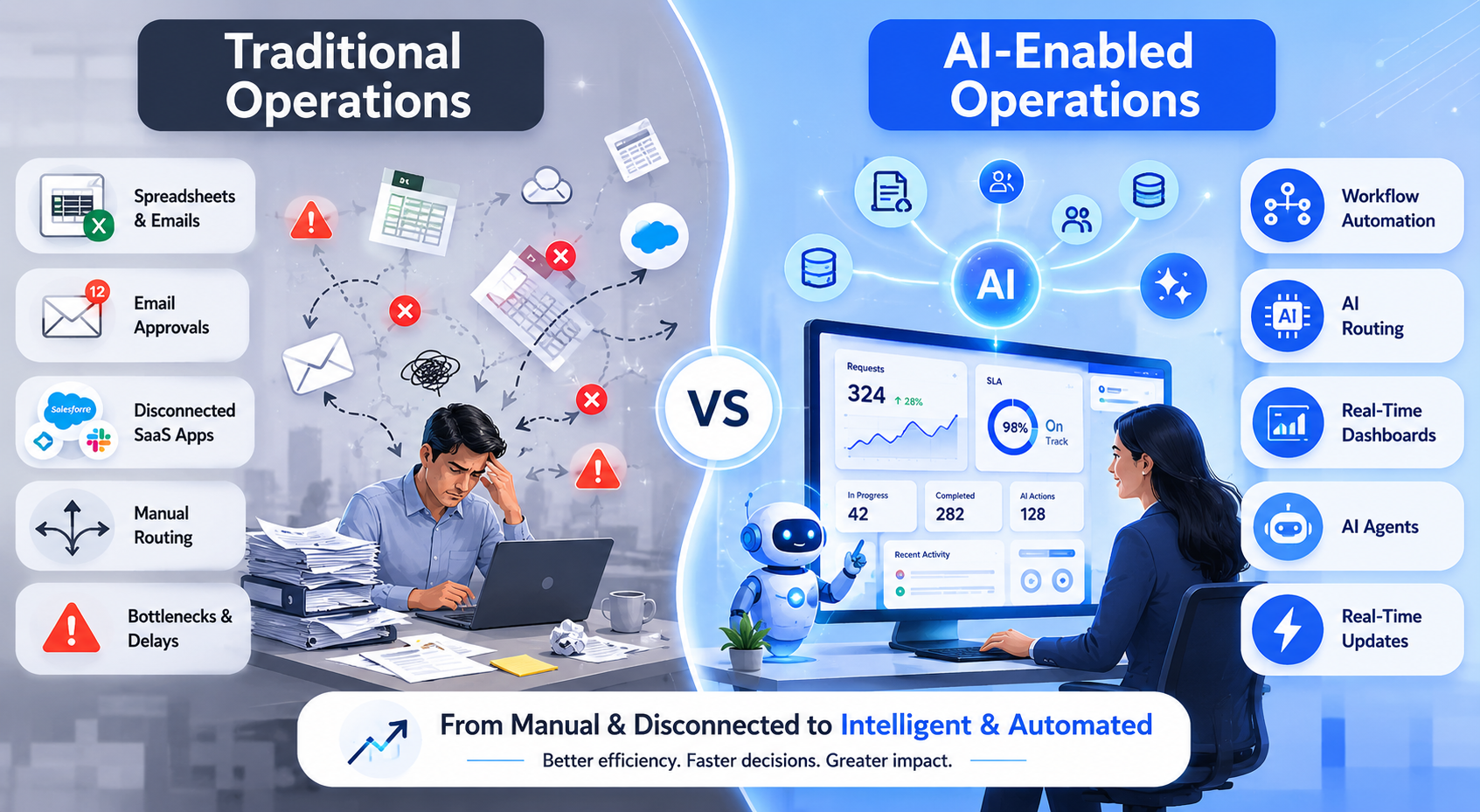
AI-enabled internal operations refer to internal business systems where workflows, data, automation, and AI-assisted decision-making are integrated into a unified operational layer.
Traditionally, internal operations were built around:
- Spreadsheets
- Email approvals
- Multiple disconnected SaaS tools
- Manual coordination
- Static dashboards
- Human routing of tasks
- Repetitive operational processes
These systems worked when organizations were smaller and operational complexity was limited. However, modern businesses now manage:
- Large volumes of operational data
- Distributed teams
- Cross-functional workflows
- Multi-system coordination
- Real-time reporting requirements
- AI-assisted customer interactions
- Increasing process automation
As complexity increases, manually operated systems become operational bottlenecks. This is where AI-enabled internal operations become important.
Instead of relying entirely on human coordination, businesses are now building systems where:
- Workflows are automatically orchestrated
- Data moves between systems in real time
- AI models assist with operational decisions
- Internal dashboards become operational interfaces
- AI agents automate repetitive coordination tasks
- Collaboration systems become workflow triggers
- Internal applications become centralized operational hubs. The shift is not simply about adding AI to existing workflows.
It is about redesigning operations around automation, orchestration, and intelligent systems.
The Core Components of AI-Enabled Operations
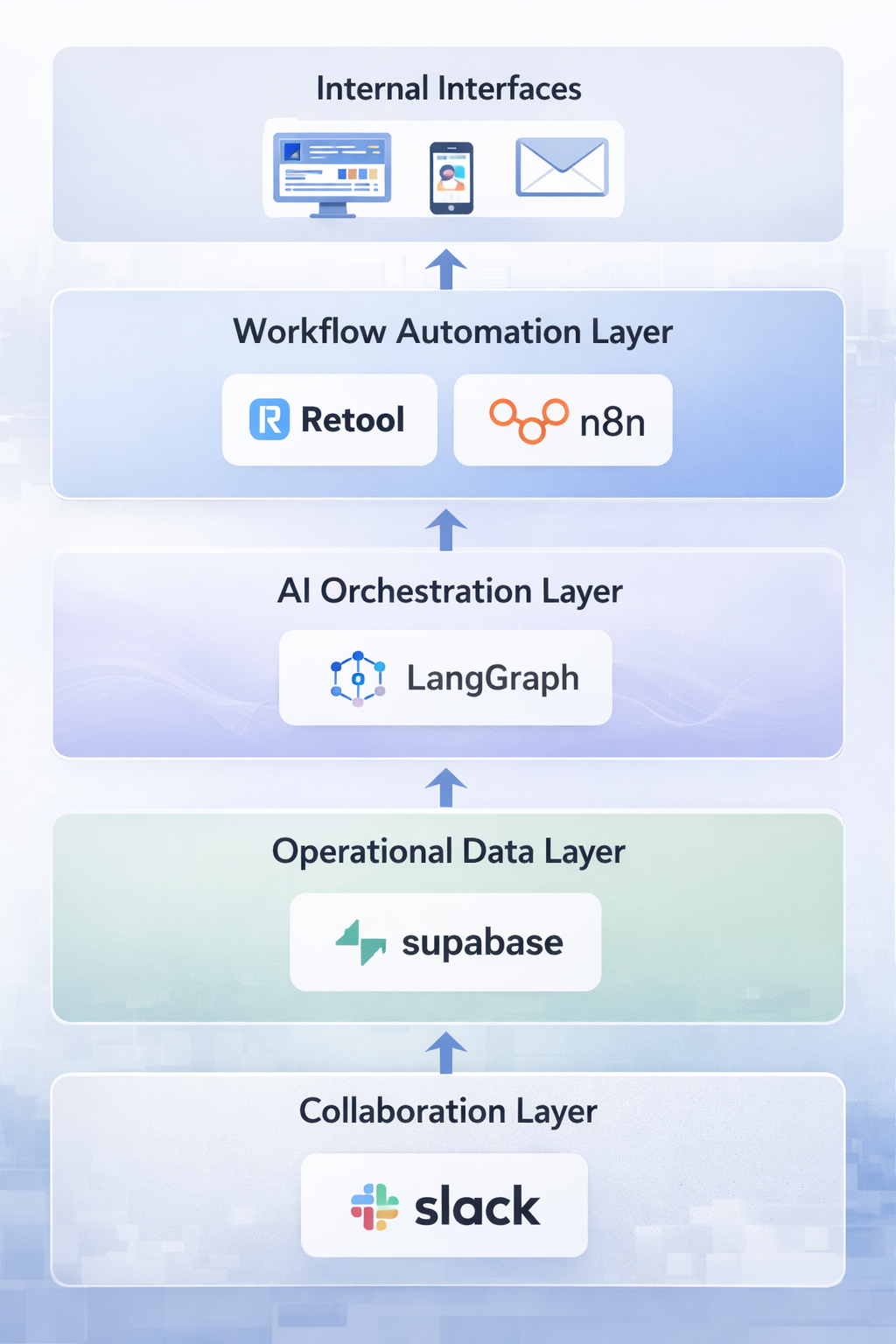
Most modern operational systems are composed of five core layers:
1. Internal Interfaces
These are the operational interfaces used by teams. Examples include:
- Internal dashboards
- Approval systemsOperational portalsAdmin interfacesWorkflow consolesMonitoring systems, platforms commonly used:RetoolAppsmithToolJetBudibase
- WeWeb
2. Workflow & Automation Layer
This layer manages orchestration.
It connects systems, triggers workflows, routes data, and automates operational processes. Platforms commonly used:
- n8n
- Make
- Zapier
- Pipedream
- Workato
- Tray.io
3. AI Orchestration Layer
This layer enables AI-assisted operations. It may include:
- AI agents
- LLM orchestration
- Workflow reasoning
- Context management
- Multi-step operational automation Platforms commonly used:
- LangGraph
- CrewAI
- Dify
- Flowise
- Langflow
- OpenAI Agents SDK
4. Operational Data Layer
This layer stores and manages operational data. Platforms commonly used:
- Supabase
- PostgreSQL
- Airtable
- Firebase
- Xano
- MongoDB
5. Collaboration Layer
This is where teams interact with workflows. Examples include:
- Slack
- Notion
- ClickUp
- Microsoft Teams
- Jira
The important point is that modern operational systems are no longer isolated applications.
They are composable systems where workflows, AI, databases, dashboards, and collaboration layers work together as operational infrastructure.
The Architecture of the Modern Internal Operations Stack
One of the biggest misconceptions around internal tooling is that operational systems are simply dashboards connected to databases.
Modern operational systems are far more sophisticated.
The most effective organizations now treat internal operations as a layered operational architecture.
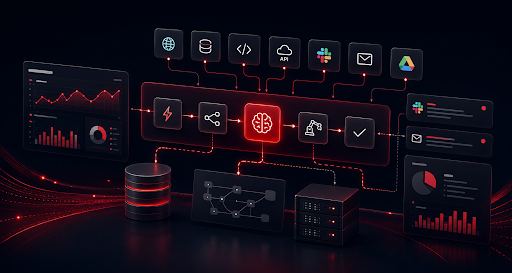
A simplified version of this architecture looks like this:
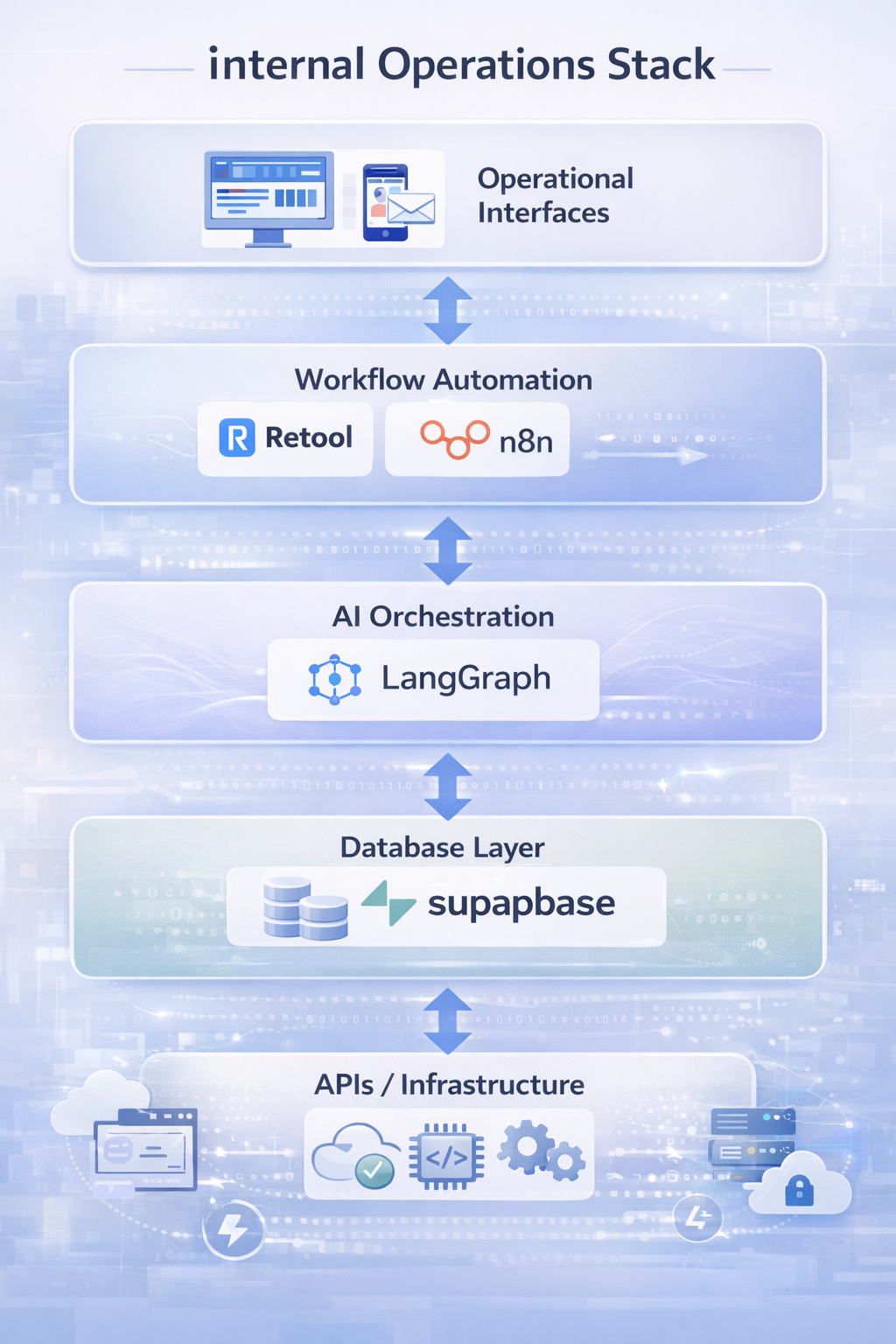
Each layer plays a distinct role.
Operational Interface Layer
The interface layer is where teams interact with operational systems. Examples include:
- Operations dashboards
- Approval systems
- Workflow management consoles
- Internal CRMs
- AI-assisted support interfaces
- Operational reporting systems
This layer is increasingly becoming AI-enabled. Modern internal tools are now capable of:
- AI-generated summaries
- Intelligent task routing
- AI-assisted approvals
- Natural language search
- AI-generated operational insights
- Embedded copilots
Best Platforms for Internal Interfaces
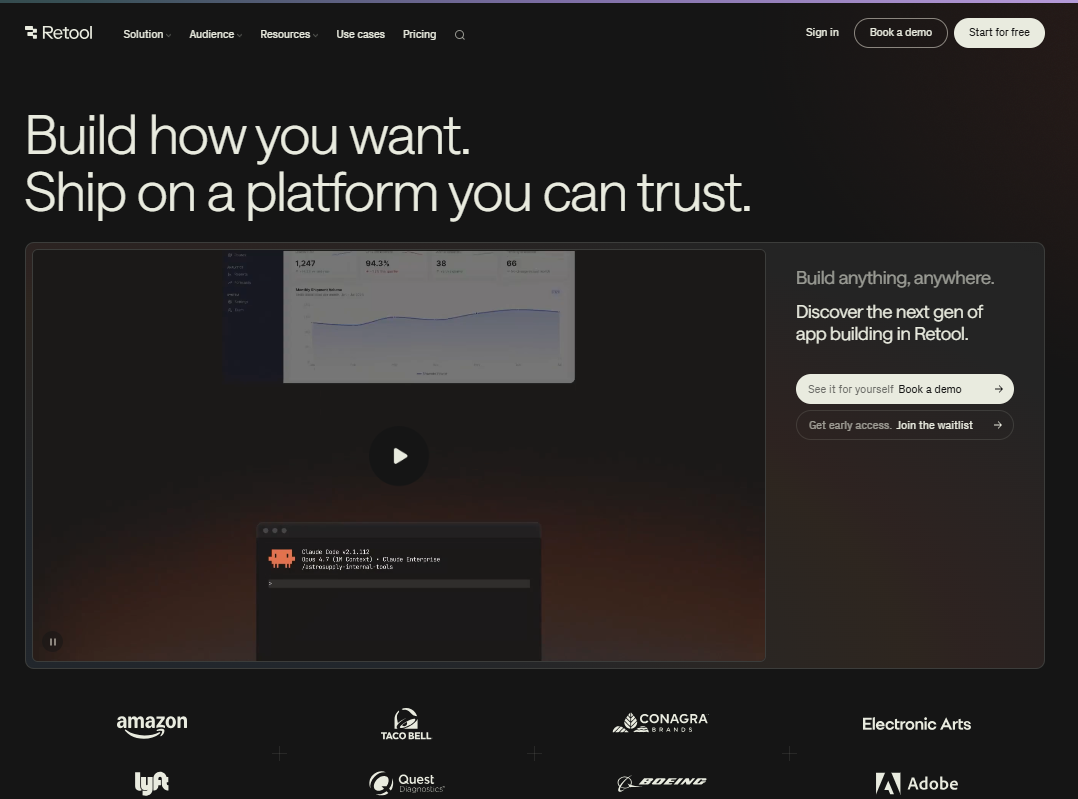
Retool
Retool is one of the most mature internal tools platforms available today.
It allows teams to rapidly build operational dashboards, admin systems, approval workflows, and internal interfaces connected to APIs, databases, and automation systems.
Retool works especially well for:
- Enterprise operations teams
- Multi-system integrations
- Internal CRUD applications
- Operational dashboards
- AI-enhanced operational tooling Its biggest strength is flexibility.
Operations teams can combine:
- Databases
- APIs
- AI workflows
- Automation triggers
- Business logic
- Role-based access
inside a unified operational interface.
Retool is particularly effective when internal systems need to scale across departments.
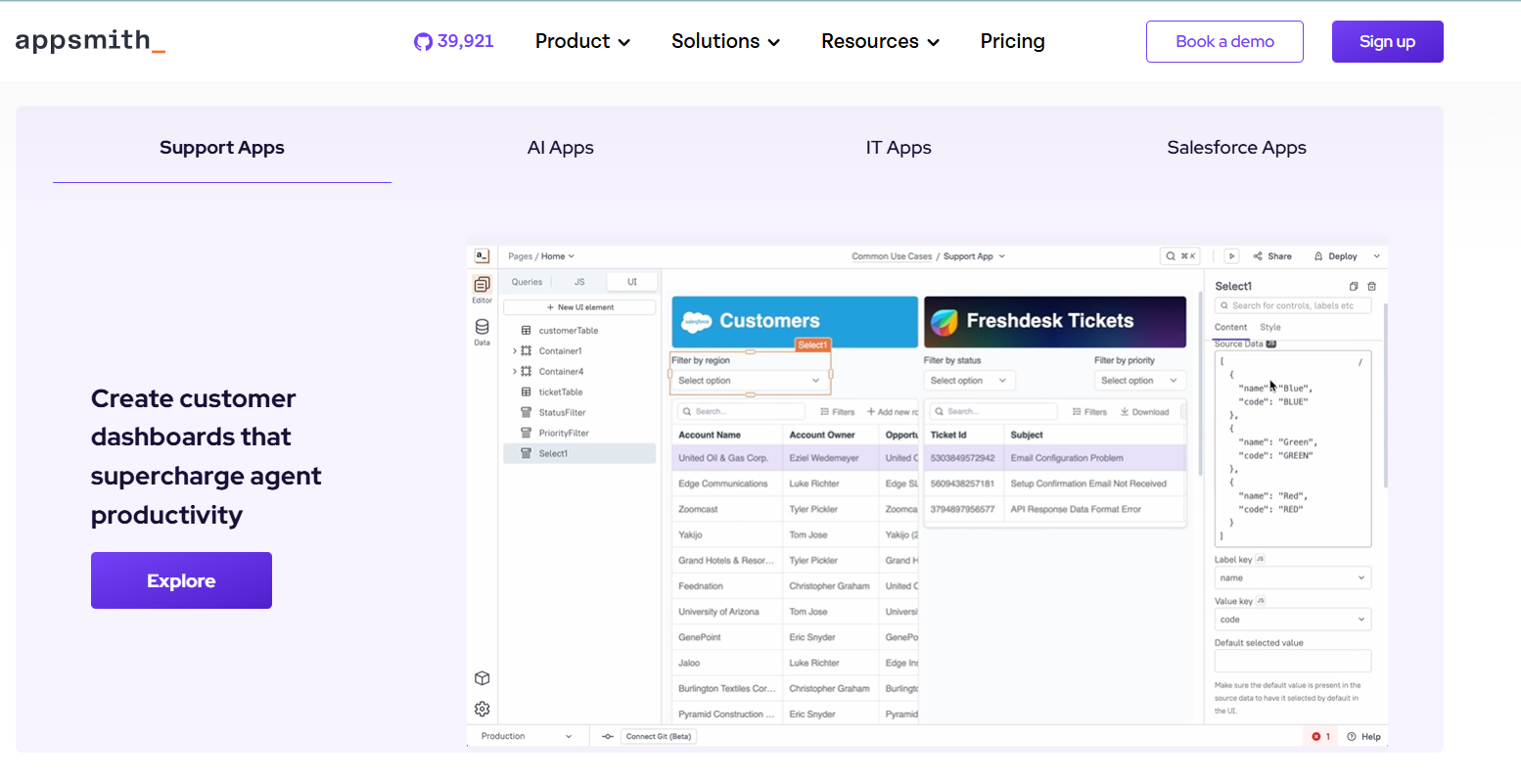
Appsmith
Appsmith is a strong open-source alternative for teams that want greater control over deployment and customization.
It is often preferred by organizations that:
- Want self-hosted infrastructure
- Require more engineering control
- Need custom integrations
- Prefer open-source operational systems
Appsmith is increasingly being used in AI-enabled workflows where businesses want tighter control over operational data.
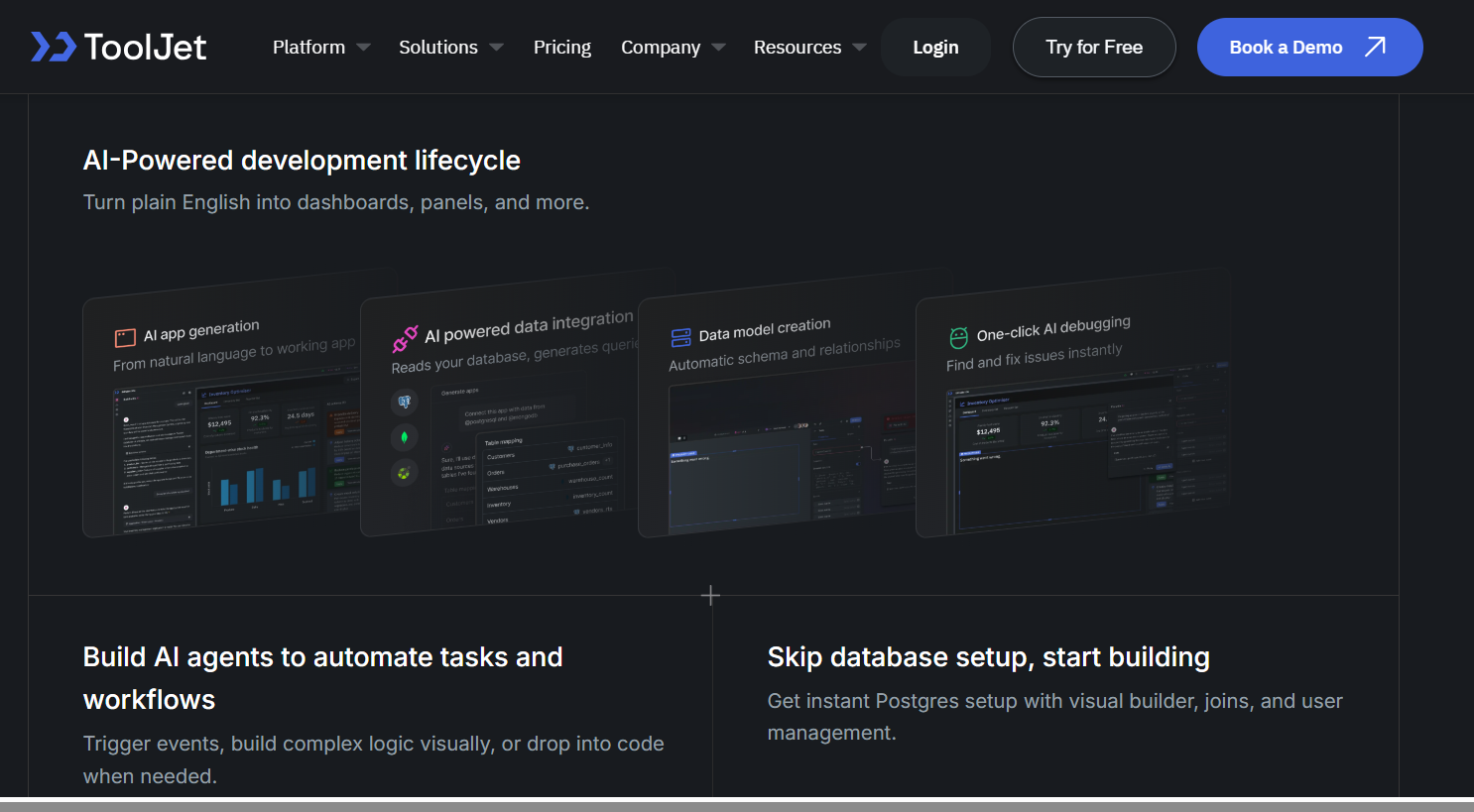
ToolJet
ToolJet focuses heavily on rapid internal application development. It supports:
- Database integrations
- Workflow integrations
- Internal dashboards
- Operational workflows
- AI integrations
ToolJet works well for organizations that need operational systems built quickly without extensive frontend engineering.
Workflow & Automation Layer
The automation layer is where modern operational systems become significantly more powerful. This layer handles:
- Workflow orchestration
- Trigger management
- System integrations
- Event-driven operations
- Process automation
- AI workflow execution
Without orchestration, operational systems become fragmented. Automation platforms effectively become the operational nervous system.
n8n
n8n has become one of the most important platforms in modern operational architecture. Unlike lightweight automation tools focused primarily on simple integrations, n8n supports:
- Complex workflow orchestration
- Conditional logic
- AI integrations
- API orchestration
- Multi-step workflows
- Self-hosted deployments
- Human-in-the-loop workflows
This makes it especially valuable for businesses building AI-enabled operations. n8n is increasingly being used as:
- an operational orchestration layer,
- an AI workflow engine,
- an integration backbone,
- and an internal automation platform.
Make
Make remains one of the most accessible workflow automation platforms for operations teams. Its visual workflow builder allows organizations to rapidly automate:
- approvals
- notifications
- CRM synchronization
- reporting workflows
- AI-assisted processes
- operational coordination Make is particularly effective for:
- SMB operations teams
- rapid automation deployments
- low-code workflow automation
- cross-platform orchestration
Zapier
Zapier remains useful for lightweight operational automation. However, it is typically best suited for:
- smaller workflows,
- non-technical teams,
- and rapid SaaS integrations.
As operational complexity increases, organizations often outgrow Zapier and migrate toward platforms like n8n or Workato.
AI Orchestration Layer
The AI orchestration layer is becoming one of the most important parts of modern operational infrastructure.
This layer enables:
- AI-assisted workflows
- Operational copilots
- AI routing systems
- Multi-step reasoning
- AI agents
- Workflow intelligence
- Autonomous operational systems
The role of AI in internal operations is expanding rapidly.
Instead of using AI as a standalone chatbot, businesses are embedding AI directly into operational systems.
Examples include:
- AI ticket triage
- AI reporting agents
- AI-generated operational summaries
- AI workflow approvals
- AI-based document processing
- AI knowledge retrieval
- AI operations assistants
LangGraph
LangGraph is increasingly becoming a preferred framework for advanced operational AI workflows. Its graph-based orchestration model allows organizations to build:
- multi-step workflows,
- AI reasoning systems,
- persistent operational agents,
- and human-in-the-loop processes.
LangGraph is particularly valuable when workflows require:
- memory,
- branching logic,
- retry systems,
- state management,
- or long-running operational processes.
CrewAI
CrewAI focuses heavily on multi-agent coordination. This is especially useful for:
- research workflows,
- operational coordination,
- AI task delegation,
- and distributed AI workflows.
Many businesses are experimenting with CrewAI for:
- support automation,
- internal analysis,
- document handling,
- and operational copilots.
Dify
Dify combines:
- LLM application development,
- workflow orchestration,
- operational interfaces,
- and AI workflow management.
It works well for organizations that want:
- AI workflow deployment,
- prompt management,
- operational AI systems,
- and AI application interfaces.
Operational Data Layer
Operational systems are only as reliable as their underlying data layer.
Modern internal operations stacks increasingly rely on flexible operational databases that support:
- APIs
- real-time updates
- workflow integrations
- AI processing
- operational analytics
Supabase
Supabase has rapidly become one of the most important backend platforms for modern internal operations.
It combines:
- PostgreSQL
- authentication
- storage
- APIs
- real-time subscriptions
- edge functions
into a unified operational backend. Supabase works particularly well for:
- operational dashboards,
- AI applications,
- workflow systems,
- and internal tooling.
Its PostgreSQL foundation makes it significantly more scalable and flexible than spreadsheet-based operational systems.
Airtable
Airtable remains one of the most accessible operational databases for non-technical teams. It works well for:
- lightweight operations,
- approvals,
- project tracking,
- workflow coordination,
- and operational visibility.
However, as operational complexity increases, many organizations eventually migrate toward more structured backend systems.
Best Internal Tools Platforms for AI-Enabled Operations
Choosing the right internal tools platform depends heavily on:
- operational complexity,
- technical resources,
- AI requirements,
- workflow maturity,
- scalability needs,
- and integration demands.
There is no single perfect platform.
The best operational stack is usually composable.
Retool
Best For
Enterprise internal applications and operational systems.
Strengths
- Extremely flexible
- Strong database support
- Excellent API integrations
- Enterprise-ready permissions
- AI workflow compatibility
- Fast internal application development
Ideal Use Cases
- Internal CRMs
- AI-enabled dashboards
- Operational reporting systems
- Approval workflows
- Admin panels
- Internal support systems
When Retool Works Best
Retool is ideal when organizations need:
- operational scalability,
- custom workflows,
- multiple system integrations,
- and engineering flexibility.
When Retool May Be Overkill
For smaller operations teams with lightweight workflows, Retool may introduce unnecessary complexity.
Appsmith
Best For
Self-hosted internal applications.
Strengths
- Open-source
- Self-hosted deployments
- Flexible architecture
- Strong developer control
- API integrations
Ideal Use Cases
- Internal admin tools
- AI operational dashboards
- Workflow systems
- Secure operational tooling
ToolJet
Best For
Rapid operational application development.
Strengths
- Fast deployment
- Visual builder
- Internal dashboards
- AI integrations
- Multi-database support
Ideal Use Cases
- Operations dashboards
- Team workflows
- Operational visibility systems
- AI-assisted operational tools
Budibase
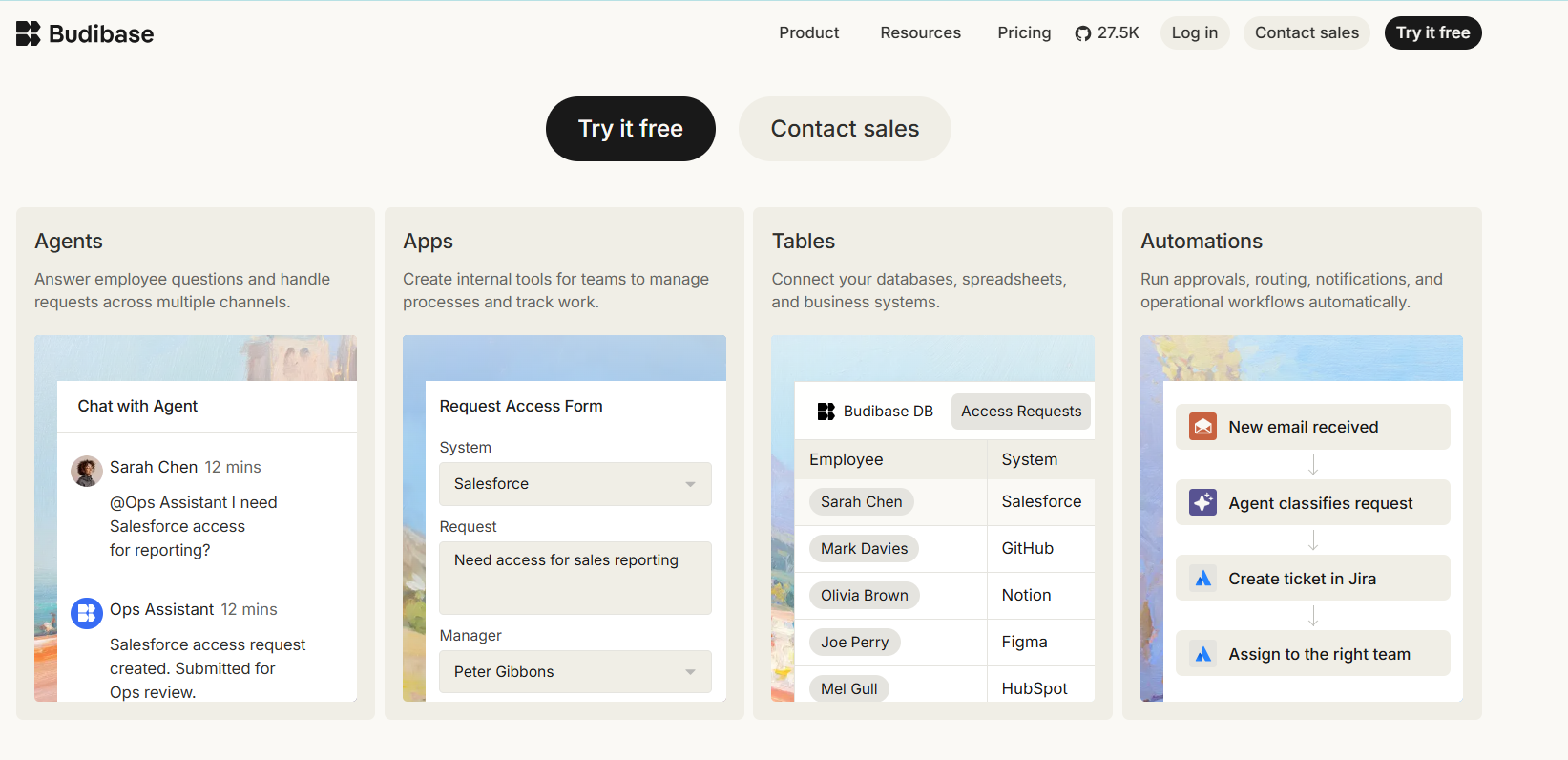
Best For
Internal process applications.
Strengths
- Open-source flexibility
- Workflow support
- Self-hosted options
- Internal automation
Ideal Use Cases
- Operational forms
- Internal workflows
- Approval systems
- Workflow management
AI Workflow Automation Systems
Workflow automation platforms are increasingly becoming operational infrastructure rather than simple integration tools.
Modern automation systems now manage:
- AI orchestration
- Multi-system workflows
- Event processing
- Internal approvals
- Reporting automation
- Operational routing
- Data synchronization
- Human review processes
The automation layer effectively acts as the coordination system between operational components.
Comparing Modern Workflow Platforms
| Platform | Best For | Technical Depth | Self Hosted | AI Workflows | Scalability |
| n8n | Complex operational workflows | High | Yes | Excellent | High |
| Make | Visual automation | Medium | No | Good | Medium |
| Zapier | Lightweight automations | Low | No | Basic | Medium |
| Pipedream | Developer workflows | High | No | Strong | High |
| Workato | Enterprise orchestration | High | No | Strong | Enterprise |
Why n8n Is Becoming a Core Operational Platform
n8n is increasingly positioned between:
- workflow orchestration,
- AI automation,
- backend logic,
- and operational coordination.
This makes it significantly more powerful than simple integration tools. Operations teams are now using n8n for:
- AI ticket routing
- AI summarization systems
- Operational monitoring
- Internal approvals
- Reporting workflows
- AI document processing
- Workflow orchestration
- Slack operational agents
The ability to self-host also gives organizations greater operational control.
AI Agent Platforms for Operational Automation
AI agents are rapidly becoming embedded inside operational systems.
However, most businesses still misunderstand what operational AI agents actually are.
Operational agents are not simply chatbots. They are systems capable of:
- executing workflows,
- making operational decisions,
- coordinating tasks,
- interacting with APIs,
- retrieving operational context,
- and escalating issues when needed.
Common Operational AI Agent Use Cases
Support Operations Agent
Workflow Example:
Support Ticket → AI Triage → Priority Detection → Knowledge Retrieval → Jira Assignment → Slack Notification
Reporting Agent
Workflow Example:
Operational Database → AI Analysis → Executive Summary → Slack Delivery → DashboardUpdate
Internal Approval Agent
Workflow Example:
Request Form → AI Validation → Policy Check → Manager Approval → Workflow Execution
Best Platforms for Operational AI Agents
LangGraph
Best for:
- persistent workflows,
- operational state management,
- advanced orchestration,
- and AI reasoning systems.
CrewAI
Best for:
Dify
- collaborative AI workflows,
- multi-agent systems,
- and operational coordination.
Best for:
- deploying AI operational applications,
- prompt management,
- and AI interfaces.
Flowise & Langflow
Best for:
- visual AI orchestration,
- rapid AI workflow prototyping,
- and operational AI experimentation.
Real AI-Enabled Operational Workflow Examples
Theory is useful.
Implementation is where operational systems actually create value.
Example 1 — AI Support Operations System
Stack
- Intercom
- OpenAI
- n8n
- Jira
- Notion
Workflow
- Support ticket enters Intercom
- AI classifies ticket type and urgency
- AI retrieves relevant documentation from Notion
- n8n routes ticket to correct team
- Jira issue is created automatically
- Slack notifications are triggered
- Human review occurs for high-risk tickets
Benefits
- Faster routing
- Reduced operational overhead
- Better support consistency
- Improved response times
Example 2 — AI Reporting Operations System
Stack
- PostgreSQL
- LangGraph
- Retool
- Slack
Workflow
- Operational data is aggregated from databases
- AI analyzes trends and anomalies
- Executive summaries are generated
- Dashboards update automatically
- Slack reports are distributed to teams
Benefits
- Faster operational visibility
- Reduced manual reporting
- AI-assisted analysis
- Real-time insights
Example 3 — AI Internal Approval Workflow
Stack
- Airtable
- Make
- Slack
- OpenAI
Workflow
- Request submitted via form
- AI validates completeness
- Workflow checks operational policies
- Approval request sent to managers
- Approved requests trigger operational actions
Benefits
- Faster approvals
- Reduced coordination overhead
- Improved process consistency
- Better operational visibility
Self-Hosted vs SaaS Internal Operations Stacks
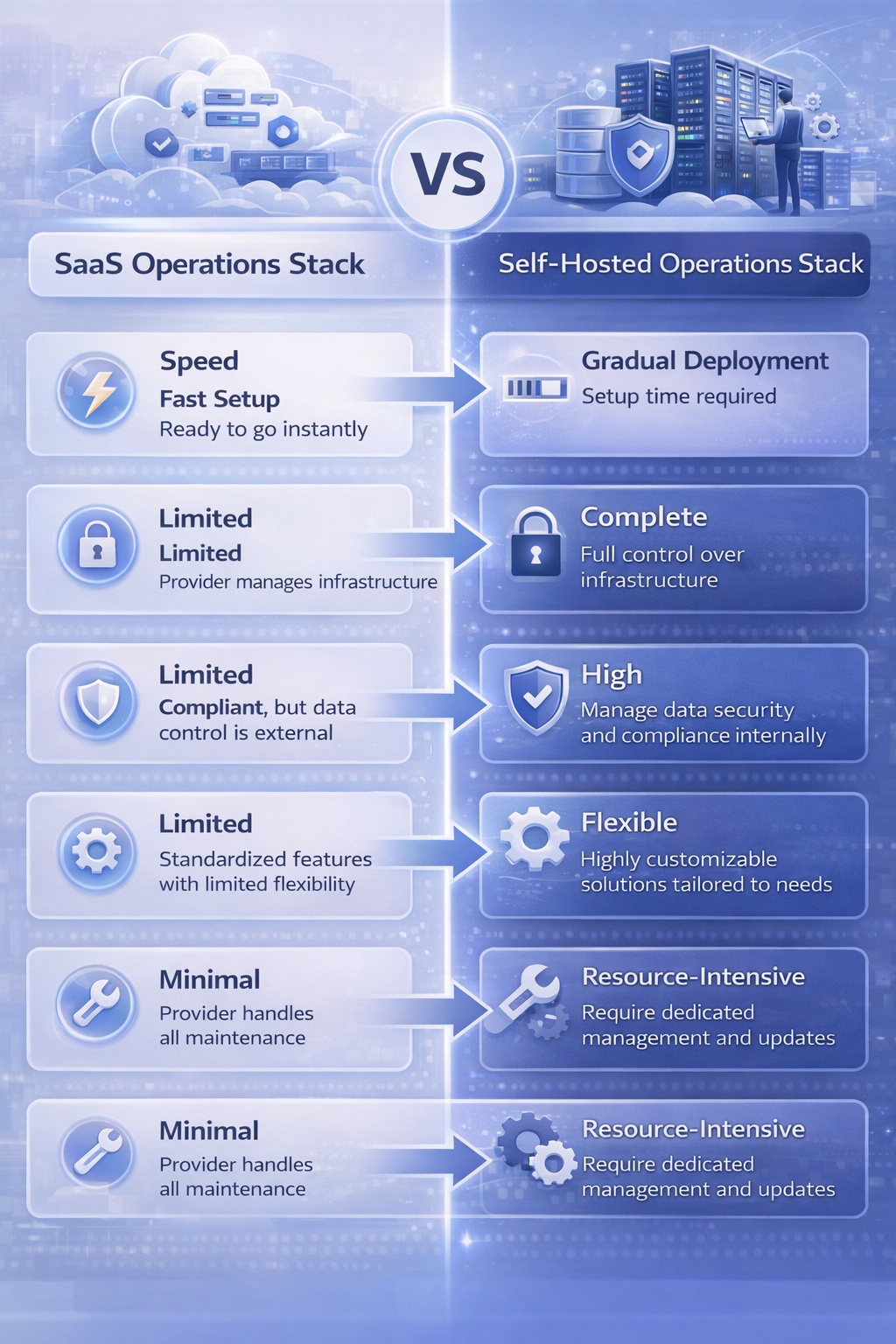
One of the most important architectural decisions in modern operational systems is whether infrastructure should be self-hosted or SaaS-based.
There is no universal answer. The decision depends on:
- operational maturity,
- security requirements,
- internal engineering capabilities,
- compliance constraints,
- and scalability needs.
SaaS Advantages
Faster Deployment
SaaS platforms reduce operational overhead and accelerate implementation.
Reduced Maintenance
Infrastructure management is handled by vendors.
Easier Adoption
Operations teams can often implement workflows without extensive engineering involvement.
Strong Ecosystem Integrations
Most SaaS operational tools support large integration ecosystems.
Self-Hosted Advantages
Greater Control
Organizations maintain full infrastructure ownership.
Better Data Governance
Sensitive operational workflows remain within internal infrastructure.
More Customization
Self-hosted systems can be deeply customized.
AI Workflow Control
Organizations can manage:
- AI infrastructure,
- workflow execution,
- data routing,
- and operational observability.
A Hybrid Model Is Becoming Common
Many organizations now combine:
- SaaS collaboration tools,
- self-hosted workflow engines,
- cloud databases,
- and AI orchestration systems.
This hybrid operational architecture often provides the best balance between:
- flexibility,
- speed,
- scalability,
- and governance.
Security & Governance Considerations
As organizations automate operations and integrate AI into workflows, security becomes significantly more important.
Operational systems increasingly manage:
- internal business processes,
- sensitive operational data,
- customer workflows,
- internal approvals,
- and AI-generated actions.
Poorly designed operational systems can introduce major risks.
Key Security Considerations
Access Control
Operational tooling should support:
- role-based access,
- permissions,
- workflow restrictions,
- and audit visibility.
API Security
Modern operational stacks rely heavily on APIs. Organizations must manage:
- token security,
- rate limiting,
- API governance,
- and integration monitoring.
AI Governance
AI systems require operational guardrails. Examples include:
- human review layers,
- prompt validation,
- escalation workflows,
- and operational monitoring.
Workflow Observability
Organizations need visibility into:
- workflow failures,
- AI execution,
- orchestration bottlenecks,
- and automation reliability.
Human-in-the-Loop Systems
Not all workflows should be fully autonomous. Critical operational decisions often require:
- approvals,
- escalations,
- or human review.
This becomes increasingly important in enterprise operational systems.
Scalability & Operational Complexity
One of the biggest challenges with automation-first operations is operational sprawl. As workflows increase, organizations often face:
- fragmented automations,
- duplicated logic,
- workflow dependency issues,
- AI reliability concerns,
- and orchestration complexity.
Scaling operational systems requires architectural discipline.
Common Operational Scaling Problems
Workflow Fragmentation
Different teams create disconnected workflows.
AI Reliability Issues
AI-generated outputs may require:
- validation,
- retry systems,
- confidence scoring,
- and escalation logic.
Lack of Centralized Governance
Without operational governance, workflows become difficult to maintain.
Operational Visibility Problems
Organizations often struggle to monitor:
- workflow health,
- execution failures,
- AI accuracy,
- and system performance.
When NOT to Use AI Workflows
Not every operational problem needs AI.
AI workflows may be unnecessary when:
- processes are extremely simple,
- workflow volume is low,
- deterministic logic is sufficient,
- compliance risks are high,
- or operational complexity outweighs automation benefits.
One of the most common mistakes businesses make is introducing AI where structured automation would work better.
Operational maturity matters.
AI should enhance workflows rather than create unnecessary complexity.
Choosing the Right Internal Operations Stack
Selecting the right operational architecture depends on:
- team structure,
- operational maturity,
- technical capabilities,
- workflow complexity,
- and AI requirements.
The best approach is usually iterative.
Businesses rarely build perfect operational systems from day one.
Instead, successful organizations progressively evolve their operational stack.
Recommended Stack Patterns
Lightweight Operational Stack
Best for:
- small operations teams,
- startups,
- and rapid deployment.
Suggested Stack:
- Airtable
- Make
- Slack
- OpenAI
Scalable Operational Stack
Best for:
- growing operations teams,
- multi-system workflows,
- and AI-assisted operations.
Suggested Stack:
- Supabase
- Retool
- n8n
- OpenAI
- Slack
AI-Heavy Operational Stack
Best for:
- advanced orchestration,
- operational AI systems,
- and AI agents.
Suggested Stack:
- LangGraph
- n8n
- PostgreSQL
- Retool
- Claude/OpenAI
Self-Hosted Operational Stack
Best for:
- enterprises,
- governance-heavy workflows,
- and operational control.
Suggested Stack:
- Appsmith
- n8n
- PostgreSQL
- LangGraph
- Self-hosted AI infrastructure
The Future of AI-Enabled Operations
The future of internal operations will be:
- automation-first,
- AI-assisted,
- workflow-driven,
- and operationally intelligent.
Internal operational systems are evolving beyond dashboards and admin panels. They are becoming intelligent operational environments capable of:
- autonomous coordination,
- AI-assisted decision-making,
- real-time orchestration,
- workflow optimization,
- and operational intelligence.
Over the next few years, businesses will increasingly adopt:
- operational copilots,
- AI orchestration systems,
- autonomous workflow agents,
- and AI-native operational interfaces.
Organizations that modernize their internal operations early will gain a significant execution advantage. Operational speed, coordination, and automation will increasingly become competitive differentiators.
The companies that continue relying entirely on fragmented manual operations will struggle to match the efficiency of automation-first organizations.
Conclusion
Modern internal operations are undergoing a major transformation.
Businesses are moving away from disconnected operational workflows toward integrated systems composed of:
- internal tooling platforms,
- workflow automation layers,
- AI orchestration systems,
- operational databases,
- collaboration infrastructure,
- and intelligent operational interfaces.
The goal is no longer simply to automate tasks. The goal is to build operational systems that:
- reduce coordination overhead,
- improve execution speed,
- increase operational visibility,
- support intelligent workflows,
- and enable teams to scale more efficiently.
The modern internal operations stack is becoming one of the most important strategic layers inside growing organizations.
Businesses that invest in AI-enabled operational infrastructure today will be significantly better positioned for the next phase of operational transformation.
At VOCSO, we help organizations design and build modern internal operational systems using AI workflows, automation platforms, orchestration architectures, internal tooling, and scalable operational infrastructure tailored to real business workflows.
Whether you are modernizing internal operations, building AI-enabled workflows, implementing workflow orchestration systems, or designing custom operational platforms, the right operational architecture can dramatically improve how teams operate at scale.












Leave a Reply